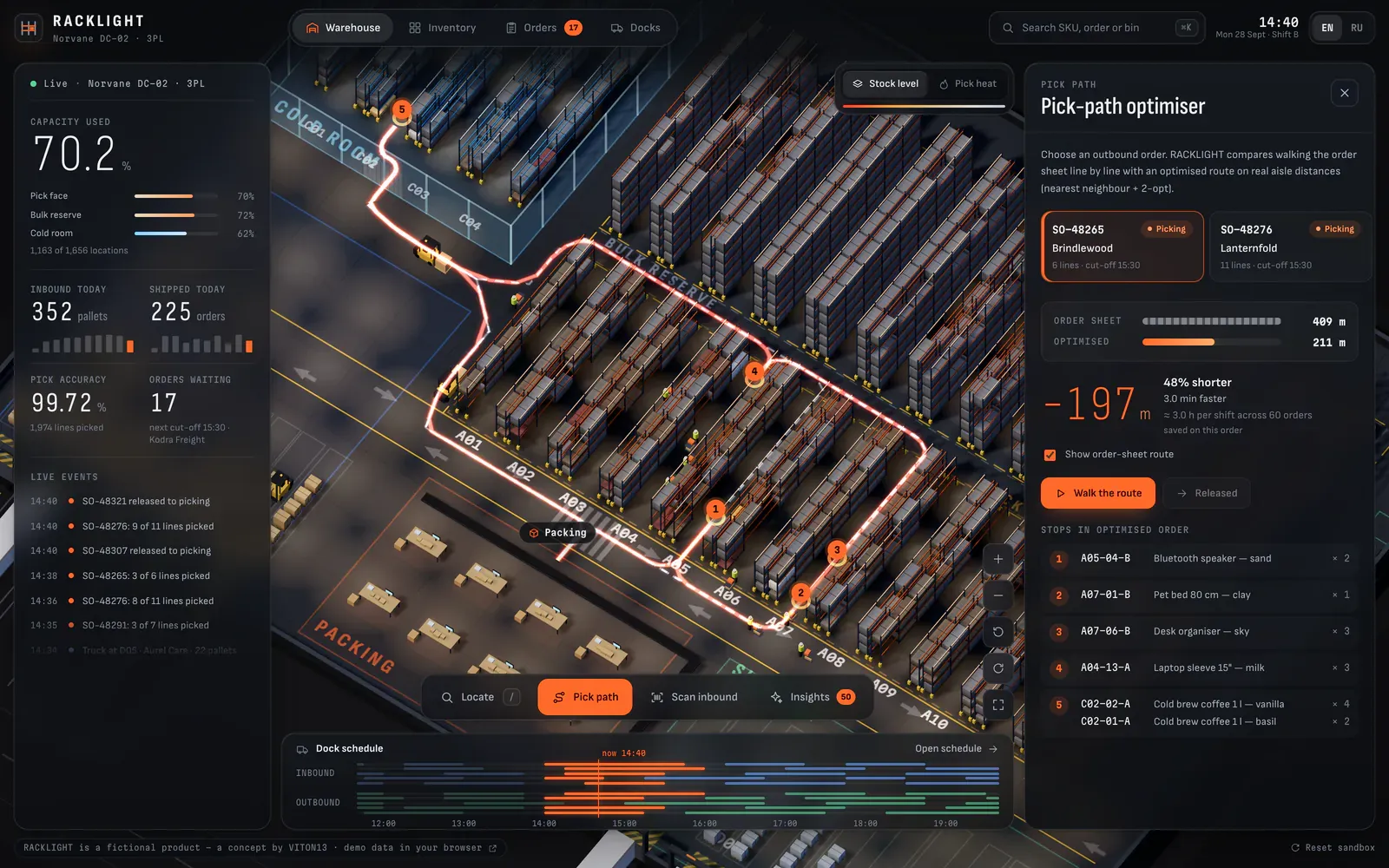
A concept WMS for a fictional 3PL warehouse: 1,656 locations as live 3D pallets, search that flies to any bin, a pick-path optimiser, inbound scanning and demo AI for stock, in English and Russian.
Overview
RACKLIGHT is a warehouse operating system that does not exist: a concept VITON13 built in September 2026 for an invented third-party-logistics site, Norvane DC-02. Warehouse software usually shows stock as tables of codes; we wanted to see what happens when the warehouse itself becomes the interface, with every pallet in view and every action visible on the floor.
The brief we set ourselves: a product a shift lead could plausibly use, not a 3D showpiece. That meant real workflows — find a pallet, walk an order, put away a delivery, act on stock problems — with the numbers behind every suggestion on screen, in English and Russian, on a laptop and on a phone.
1,656
bin locations drawn as live 3D pallets, coloured by stock
Source: Demo source files, 28 Sep 2026
400
fictional SKUs, each with 90 days of demand and a forecast
Source: Demo source files, 28 Sep 2026
−32%
pick-walk length vs the order sheet (median, 1,140 generated orders)
Source: Measured 28 Sep 2026, the demo’s routing code
10 KB
first script gzipped; the 3D scene (154 KB) loads after it
Source: Measured 28 Sep 2026, build files
Approach
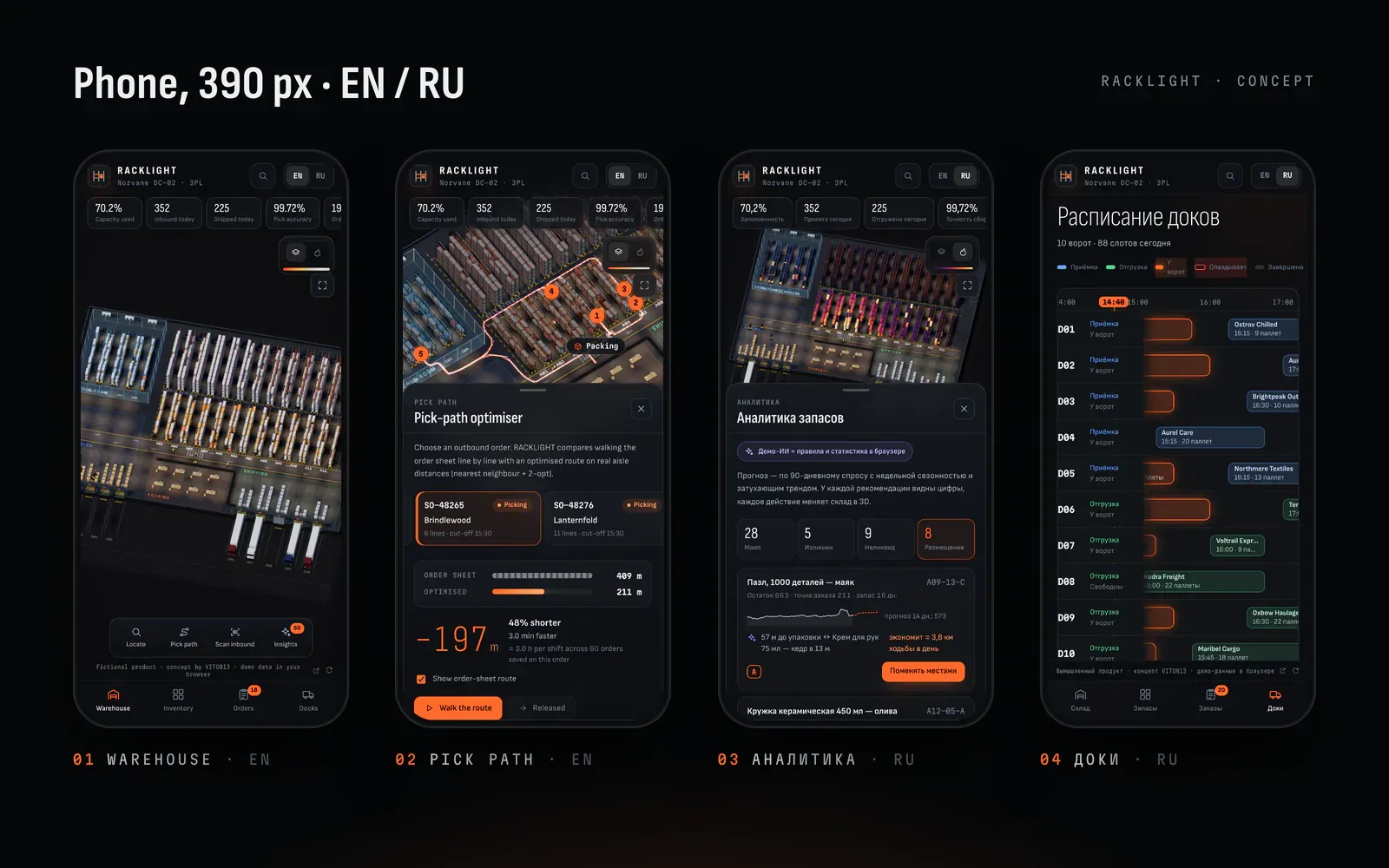
The warehouse is a three.js scene with an orthographic, isometric camera: a 108 × 80 m building with 12 main aisles, 4 aisles in a glass cold room, receiving, packing, shipping and 10 dock doors. Its 1,656 bin locations are instanced pallets coloured by stock level, or by pick frequency in heat mode; nine pickers and five forklifts move along the aisle graph, and trucks reverse onto the docks on schedule. Everything is procedural: no models, no image textures, no external requests.
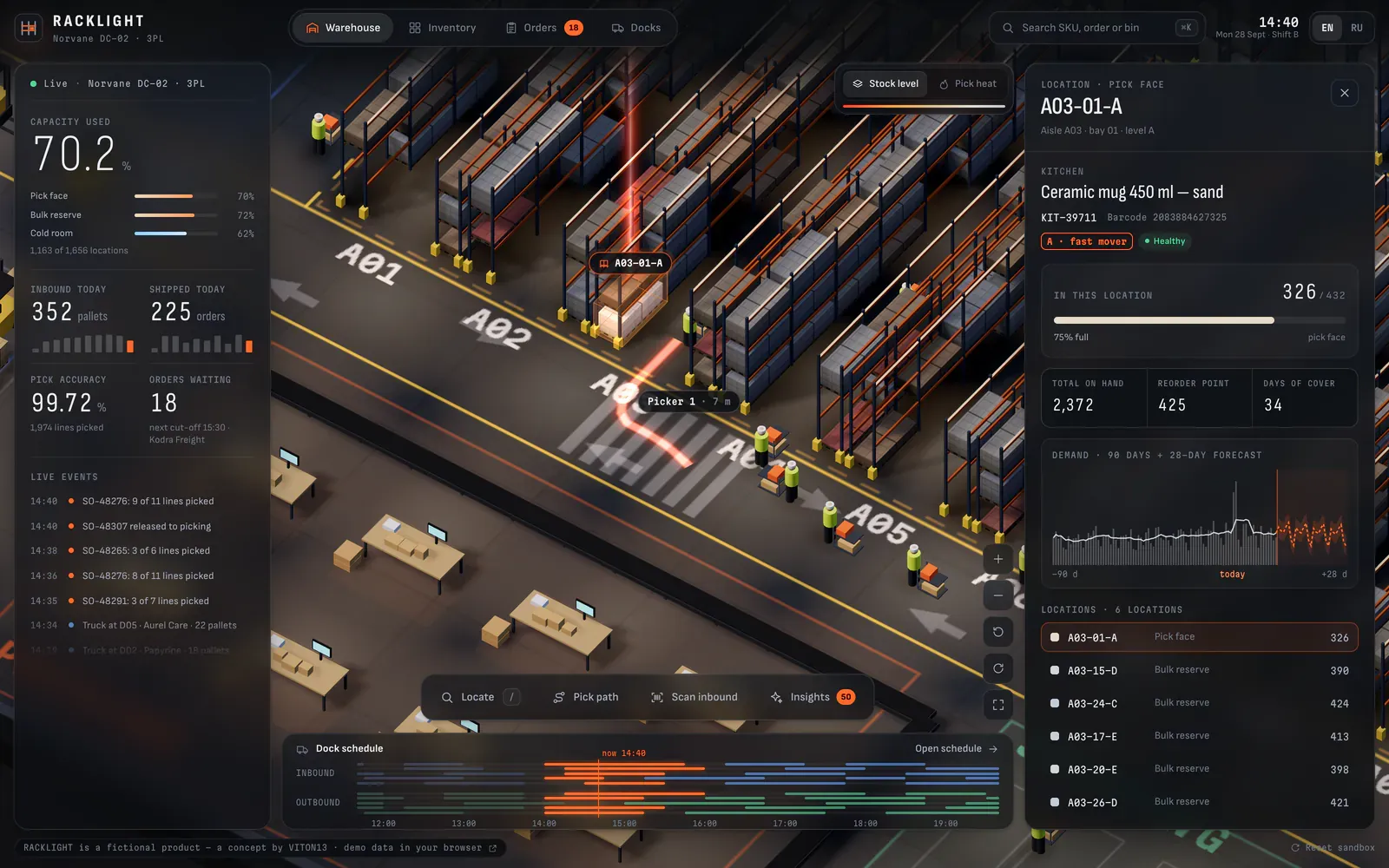
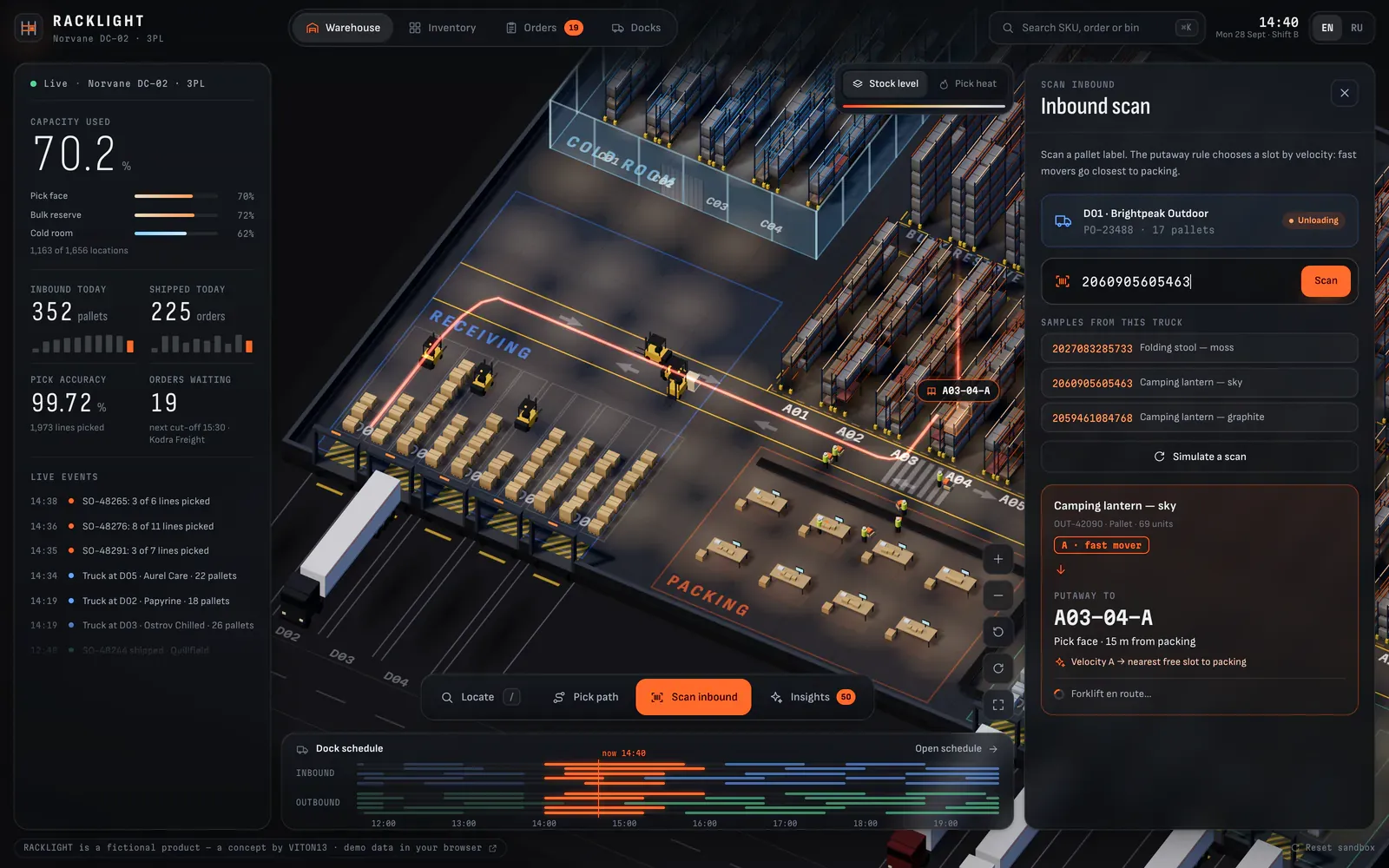
Search (⌘K) covers the 400 SKUs, orders and bin codes: the camera flies to the bin, a beam of light marks it and a path runs from the nearest picker. The pick-path optimiser compares the order sheet’s sequence with a route built by nearest neighbour and 2-opt on real aisle distances, then sends a picker to walk it. An inbound scan chooses a slot by velocity — fast movers nearest packing, chilled goods in the cold room — and a forklift carries the pallet there.
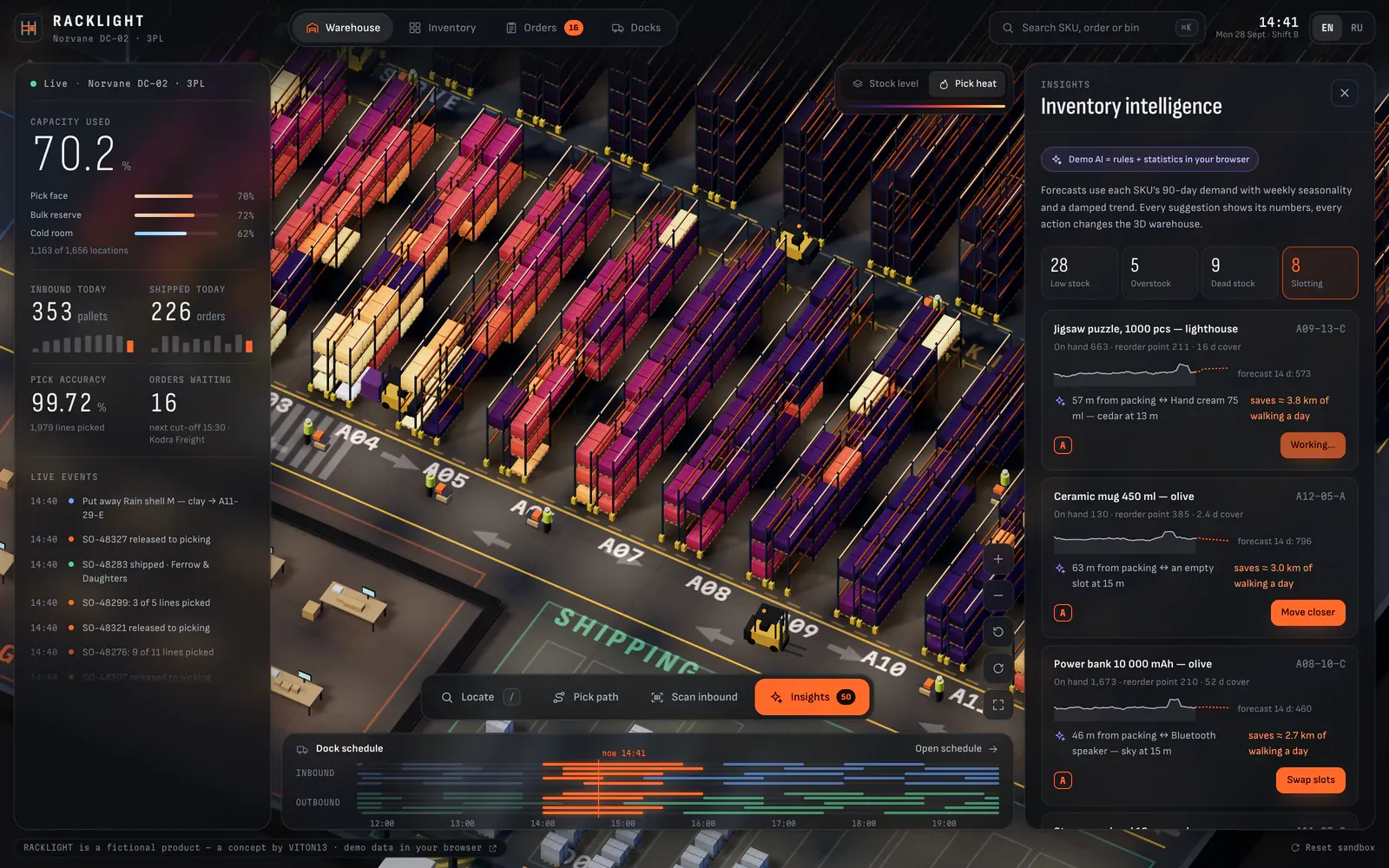
Inventory intelligence is demo AI, and says so: rules and statistics that run in the browser. Each SKU has 90 days of generated demand with weekly seasonality; a damped-trend forecast sets reorder points and flags low stock, overstock, dead stock and slotting swaps, and every action changes the 3D scene. Dashboard panels, an Inventory table, an Orders queue and a Docks schedule complete it; the shell is plain JavaScript, and the 3D scene loads after it.
Gallery
Results
The concept runs at tarasovvitalii.com/demos/racklight/ with four views, four tools and about 230 interface strings in each language. On 28 September 2026 we measured the production build: the first script is 10 KB gzipped, and the three.js scene, 154 KB gzipped, loads after the interface has painted; the whole build is 1.0 MB, with no image, model or texture files.
We ran the demo’s own routing code on the 1,140 orders it generates over 30 days: the optimised route was a median 32% shorter than walking the order sheet line by line (the order on screen goes from 409 m to 211 m). In headless Chrome on a MacBook Air with an Apple M5, at 1600 × 1000 on a Retina scale, the scene held 55–60 fps under the default 60 Hz frame clock in six states and rendered 160–200 fps with the cap removed.
What this does not prove
RACKLIGHT is a concept VITON13 built to show range, not a commissioned product. Norvane DC-02, its customers, carriers, suppliers, SKUs and every number are fictional and generated in the browser; there are no users, no clients, no warehouse and no revenue behind it. The demo AI is rules and statistics running on the visitor’s device, not a language model, and it was not trained on real demand.
The route saving is measured against an unsorted order sheet on generated orders; against a sheet simply sorted by location code the median gain falls to about 9%, and a real warehouse adds congestion, carts and batch picking. Frame rates and sizes are lab measurements on one machine in headless Chrome on 28 September 2026; nothing here connects to a real WMS, scanner or dock. Our first Lighthouse check, on a local copy on a heavily loaded machine, gave the phone test only 37, because building the 3D scene in one go kept a throttled CPU busy for seconds. We then split the boot into short steps that yield to the browser and compiled the shaders asynchronously: in our own check with the CPU slowed four times, blocking time fell from about 1.3 s to about 20 ms, and on the live address on 28 September Lighthouse gave 86 on mobile and 99 on desktop (medians of five runs, load average 3–9), with accessibility at 91–92 because a small counter on a tool button and the “fictional product” badge link still need fixing. These are lab tests with a simulated phone, not measurements on real devices.
Planning something similar? Our founder, Tarasov Vitalii, reads every message himself.
Order a similar project on VITON13 Studio
Next project
HOURLINEConcept booking platform (web app) Concept2026
All work (32)
Concept2026
All work (32)