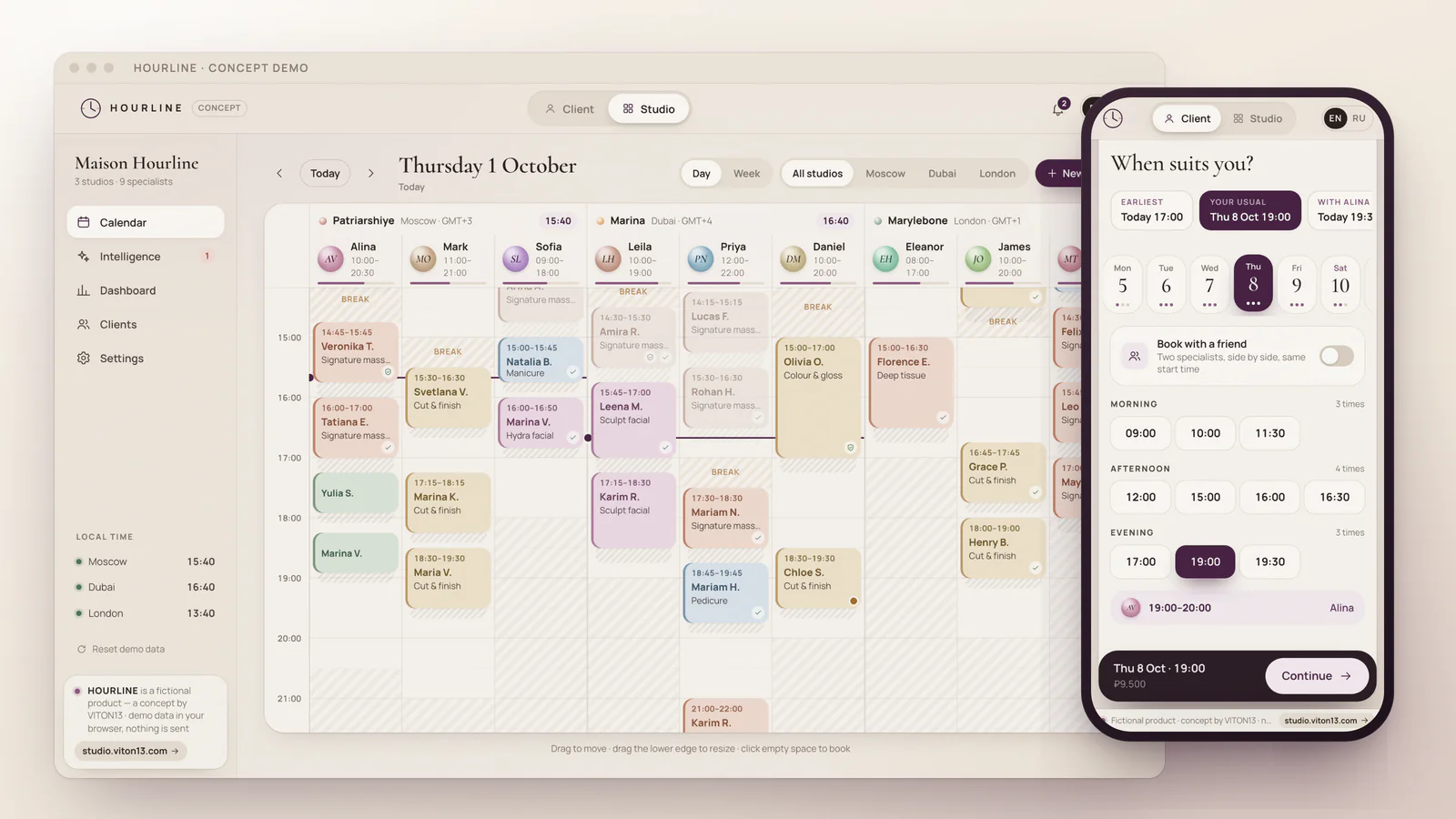
A concept booking platform for a fictional network of three premium studios in Moscow, Dubai and London: a phone-first booking page for guests and a back office for the studio, both running in the browser.
Overview
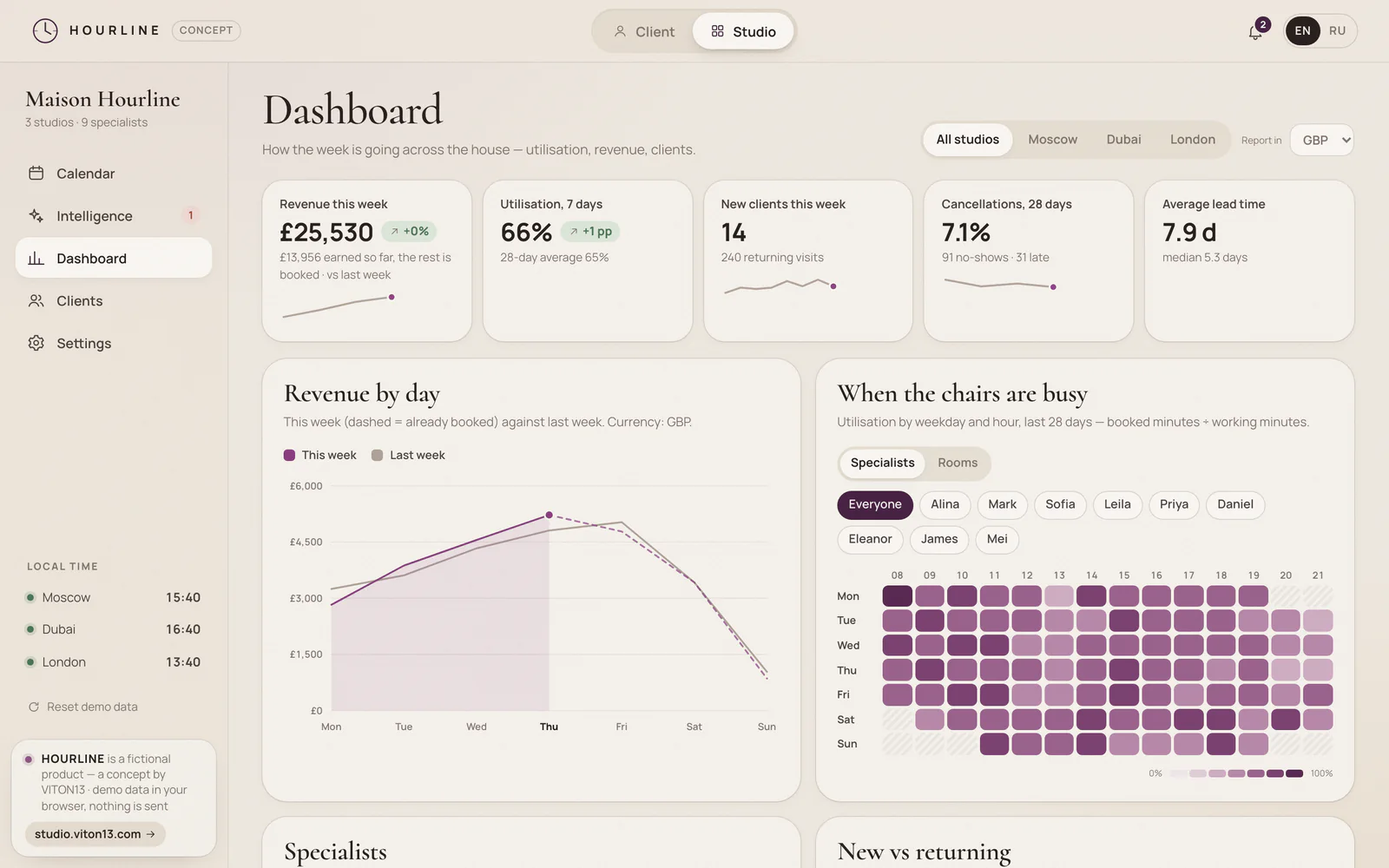
HOURLINE is an online booking platform we designed and built as a concept, shown through a fictional business: Maison Hourline, three premium studios in Moscow, Dubai and London with nine specialists offering massage, facials, hair, nails and physio. A switch in the top bar flips between the two sides of the product: the booking page a guest sees and the back office the studio runs on.
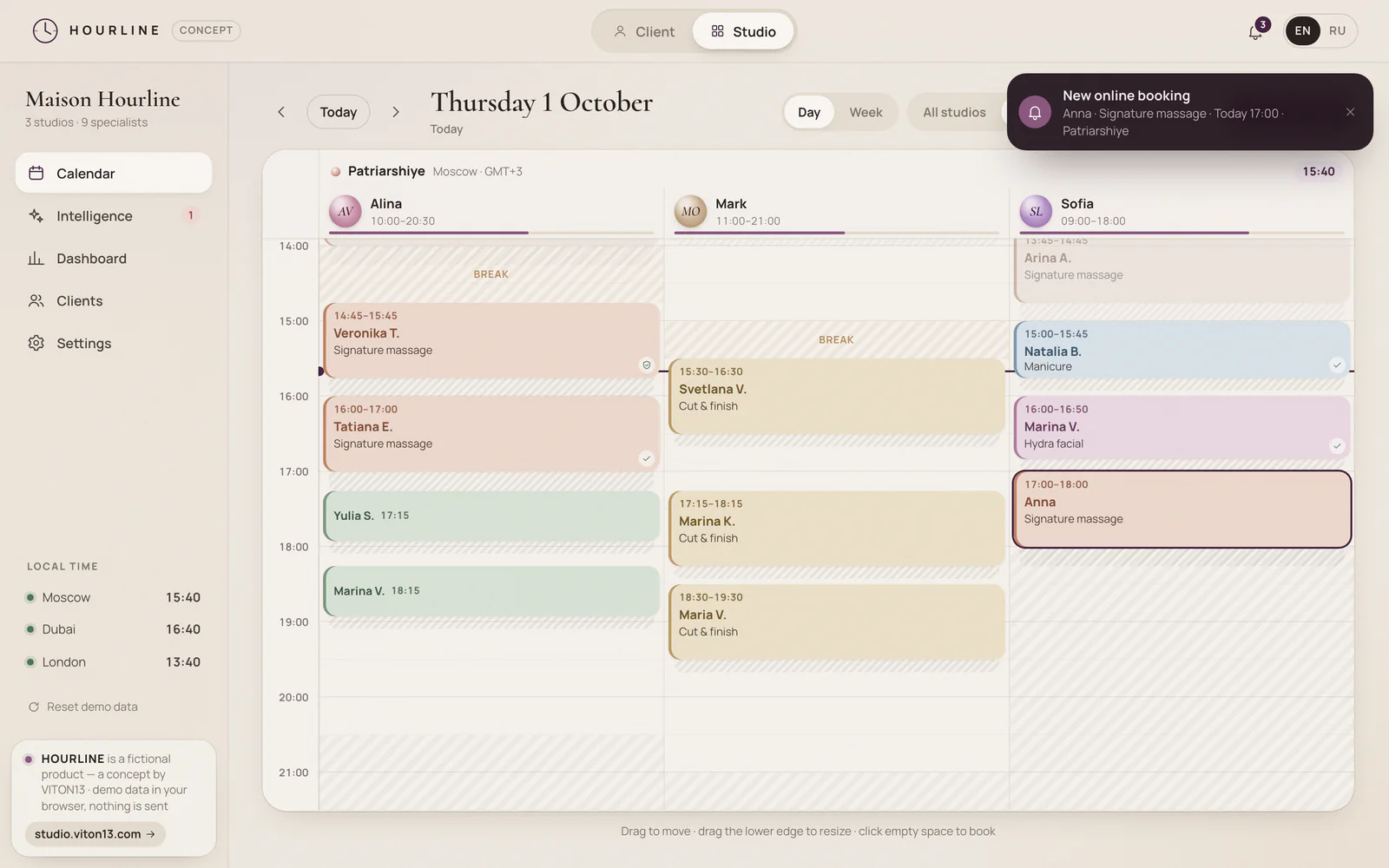
The brief we set ourselves: booking should take seconds on a phone, availability had to be real rather than a decorative grid, and the studio should see every booking the moment it is made. Everything runs in the visitor’s browser: the demo data is generated for each visitor, kept in localStorage and never sent anywhere.
6 s
scripted phone booking, first tap to confirmation (median of 14 runs)
Source: Measured 28 Sep 2026, headless Chrome, demo stopwatch
658
offered times re-checked by an independent audit: 0 conflicts
Source: Measured 28 Sep 2026, 10 days × 3 studios × 9 services
95 KB
all JavaScript and CSS gzipped (fonts not included)
Source: Measured 28 Sep 2026, build files
94 / 100
Lighthouse performance, mobile / desktop (medians of 5 runs)
Source: Measured 28 Sep 2026 on the live address
Approach
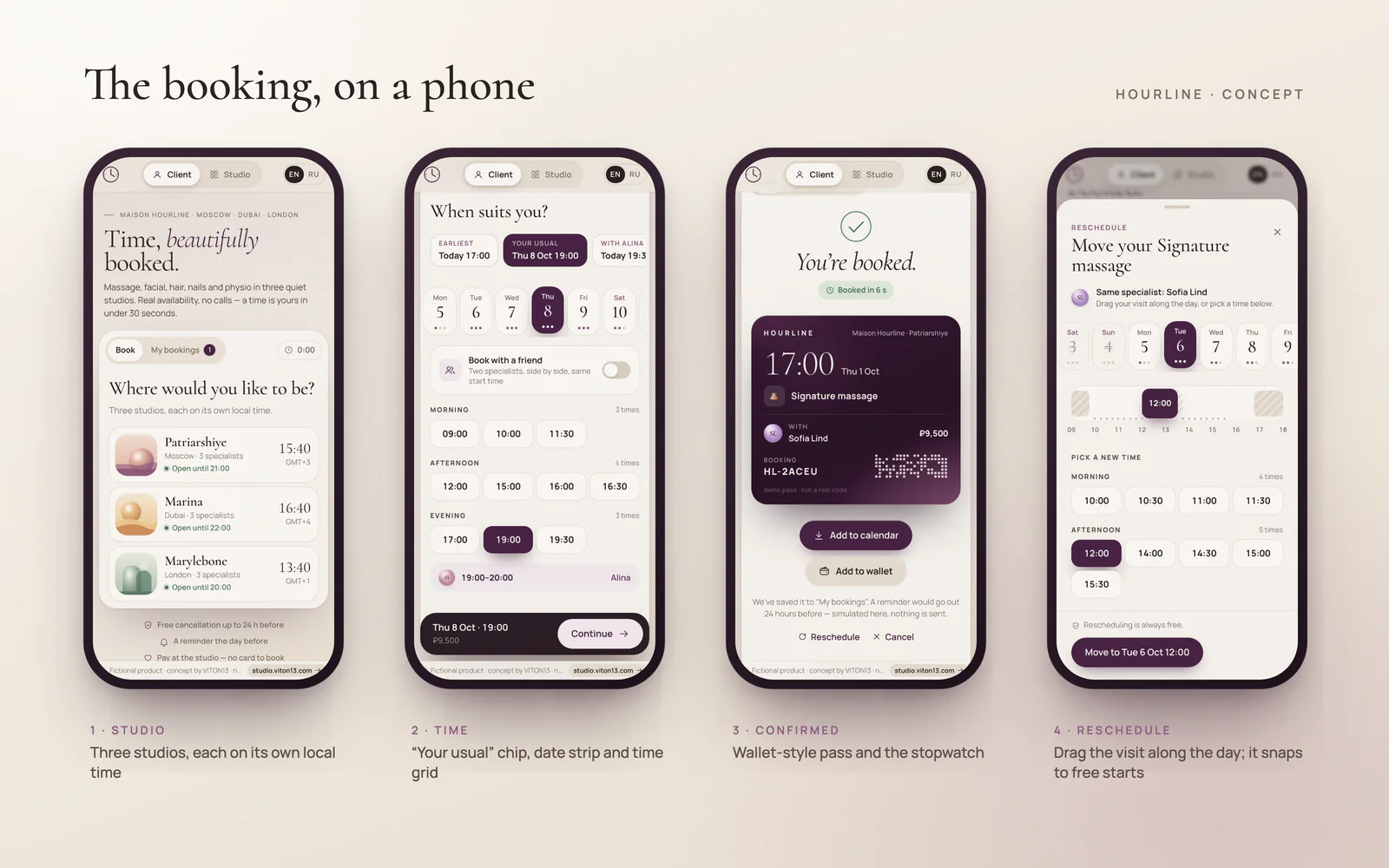
The guest goes from studio to service, specialist, a date strip with a time grid, name and phone, and a confirmation. Each studio shows its own local time and whether it is open. Suggestion chips offer the earliest time, “your usual” time learned from past visits and a time with the usual specialist; “book with a friend” finds two specialists free at the same start. The confirmation is a wallet-style pass with a real .ics file generated in the browser, and a visit can be moved by dragging it along the specialist’s day or cancelled under the studio’s policy.
Behind every offered time is one availability engine: each specialist’s weekly hours and breaks, existing bookings, a turnover buffer after every appointment, a minimum lead time and a booking horizon, all computed in the studio’s own time zone, London’s clock change included. The studio calendar runs on the same engine: day and week views, drag to move, drag the lower edge to resize, click to create; a drop that breaks a rule shakes back and says why.
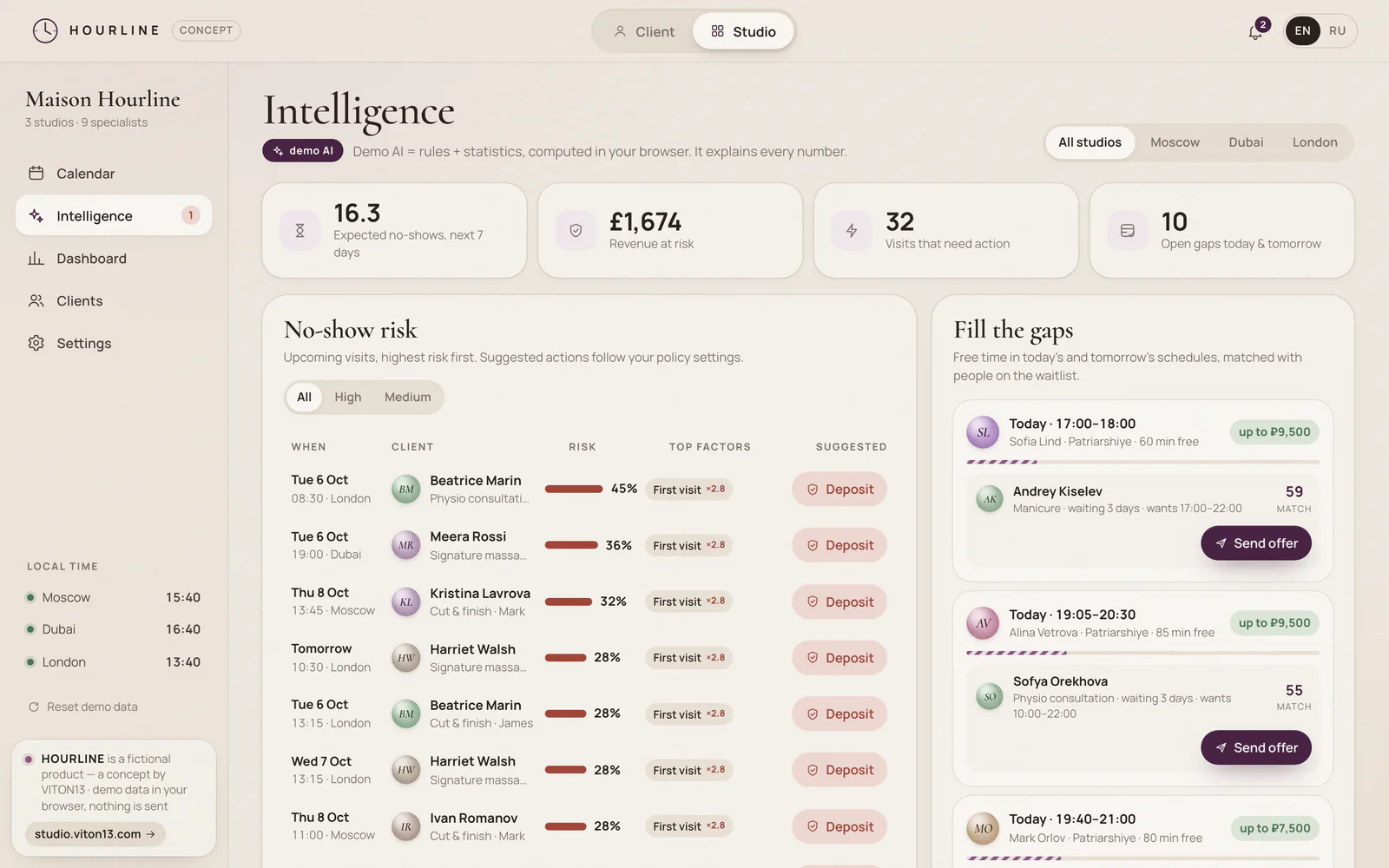
The studio side adds what we call demo AI, labelled on the page as rules plus statistics in the browser: a no-show risk for every upcoming visit from a naive Bayes model trained in the browser on the sandbox’s own history, with its factors explained and a suggested action, and “fill the gaps”, which matches free time with a simulated waitlist. A dashboard with a utilisation heatmap, a client base with tags and history, and settings that reach the booking page instantly complete it. No framework: plain JavaScript and CSS bundled with esbuild, two self-hosted fonts, Cormorant and Manrope, on a cream-and-stone palette with an aubergine accent.
Gallery
Results
The concept runs at /demos/hourline/ with seven views, two on the guest side and five in the studio, in English and Russian. On 28 September 2026 we measured it ourselves in headless Chrome on a MacBook, with the demo clock frozen at 1 October 2026, 15:40: a scripted booking on a 390 px phone screen, pausing 0.9 s after each tap, took 6 s from the first tap to the confirmation on the demo’s own stopwatch (median of 14 runs, range 6–16 s). A booking made in one tab appeared in a studio calendar open in a second tab.
An independent brute-force check re-tested all 658 times the engine offered over ten days in three studios and nine services against hours, breaks, bookings with their buffers, lead time and the time-zone round trip: no wrong slot, no double booking, no buffer violation, and the same check across London’s clock change on 25 October found none either. All the JavaScript and CSS together weigh 95 KB gzipped. On the live address, Lighthouse 13.5 (five runs per device, medians, on a MacBook with a load average of 3–9) gave performance 94 on mobile and 100 on desktop, with accessibility and best practices at 100, and the page transfers 0.2 MB.
What this does not prove
HOURLINE is a concept VITON13 built to show range, not a commissioned project. Maison Hourline, its studios, specialists, clients, prices and bookings are fictional and generated in the browser: there is no client, no users, no real bookings, no traffic and no revenue. Reminders, deposits, waitlist offers and their replies are simulated, and nothing is sent to anyone.
The demo AI is rules and statistics in the browser, not a language model, and it learns from invented history, so it says nothing about predicting real no-shows. The 6 seconds come from a script tapping at a fixed pace, not from people, and there was no user testing. All figures are lab measurements in headless Chrome on one machine on one day; Lighthouse ran on the live address, but with a simulated phone rather than real devices. A production version would still need a server, slot locking, payments, reminders and accounts.
Planning something similar? Our founder, Tarasov Vitalii, reads every message himself.
Order a similar project on VITON13 Studio
Next project
SOLVENTCash-flow web app concept Concept2026
All work (32)
Concept2026
All work (32)