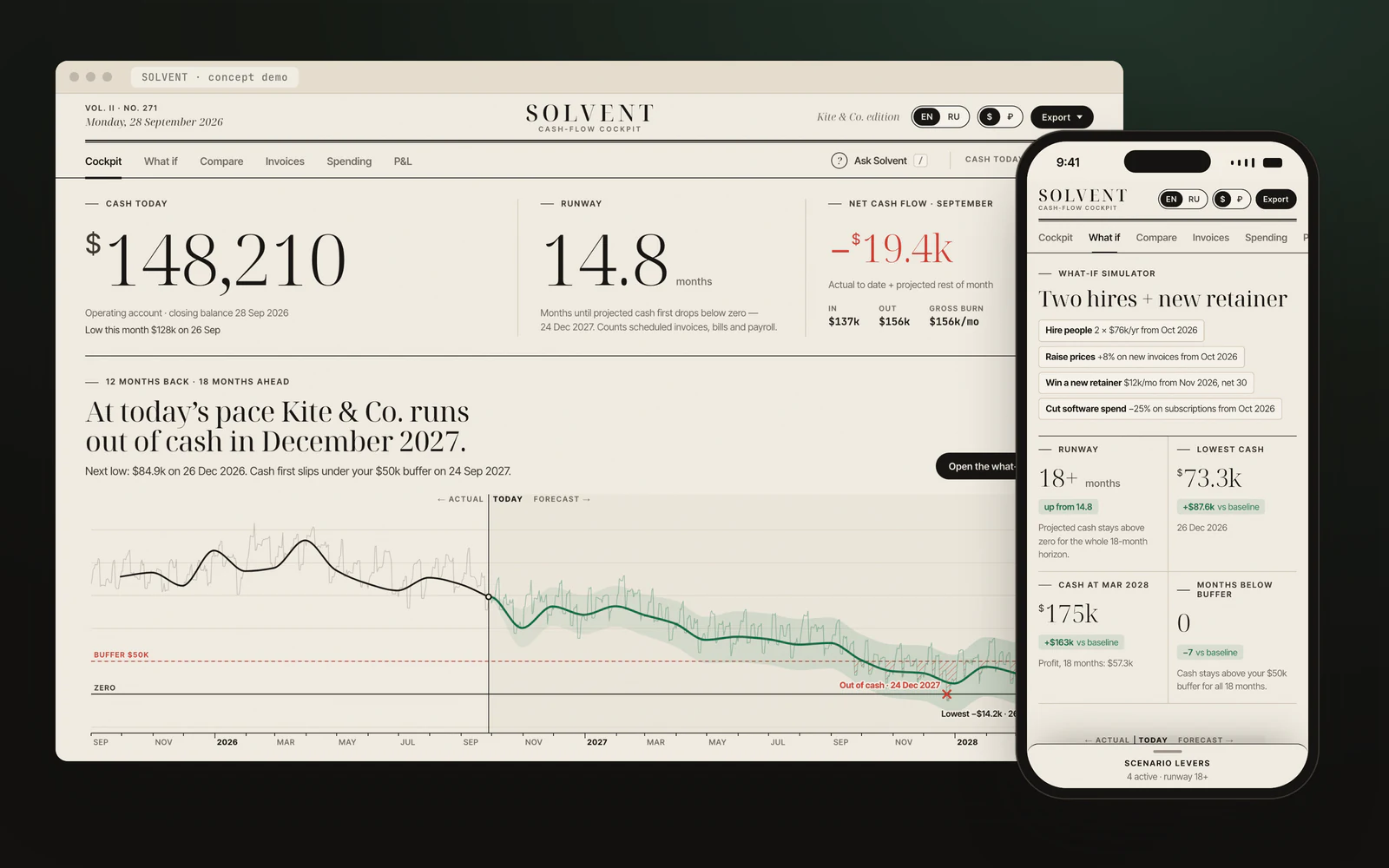
A product concept: a cash-flow cockpit and what-if simulator for small businesses. Cash, runway and an 18-month forecast for a fictional studio, with eight levers that redraw it instantly.
Overview
SOLVENT is a product concept VITON13 built on 28 September 2026: a cash-flow cockpit and scenario simulator for small businesses. It runs on the demo books of Kite & Co., an invented 14-person design-and-print studio, and answers the questions an owner asks before payroll: how much cash is there, how many months will it last, and what happens if we hire, raise prices or lose our biggest client.
We set ourselves two rules. Every number on screen comes from one model and has its definition on the page, so the cockpit, the simulator, the exports and the assistant never disagree. And the whole product runs in the browser, with no server, no analytics and no request to anyone else, and says plainly that it is a model, not financial advice.
8
scenario levers and 9 presets; every change recomputes the 18-month forecast
Source: App source files, 28 Sep 2026
1,927
automated checks of the maths, all passing (npm test)
Source: Measured 28 Sep 2026, test suite
72 KB
all JavaScript gzipped (220 KB raw), no chart, UI or PDF library
Source: Measured 28 Sep 2026, build files
0
requests to other servers across all sections, desktop and phone, exports included
Source: Measured 28 Sep 2026, headless Chrome
Approach
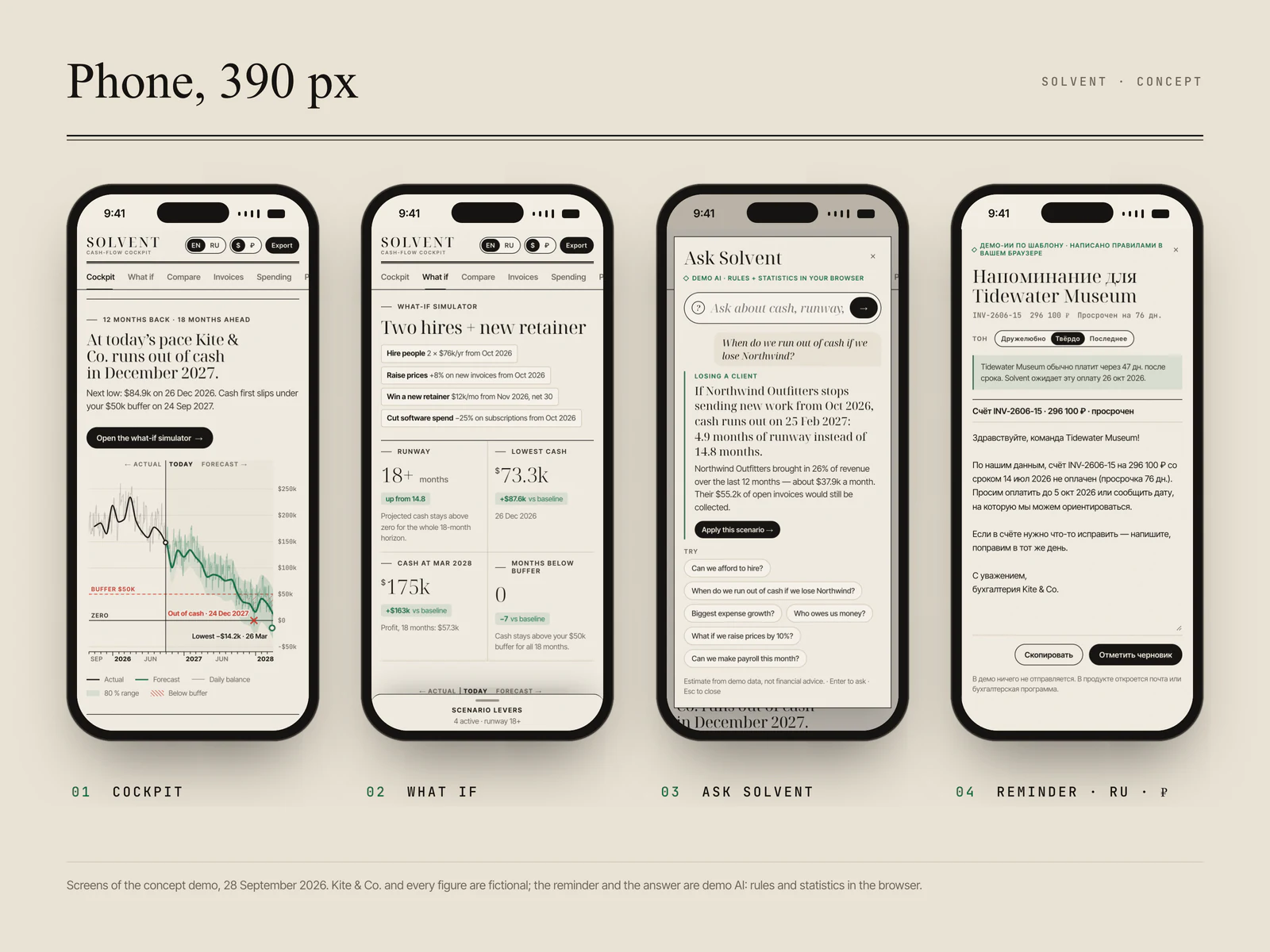
The interface reads like a financial newspaper rather than a dashboard: a masthead with the day’s issue number, serif headlines that state the conclusion (“At today’s pace Kite & Co. runs out of cash in December 2027.”), mono figures and hairline rules on warm paper, and a night edition. The cockpit shows cash today, runway, this month’s net flow and one chart: 12 months of actual balance and 18 months of forecast with an 80 % band, the cash buffer, the zero line, the lowest point and the day the money would run out.
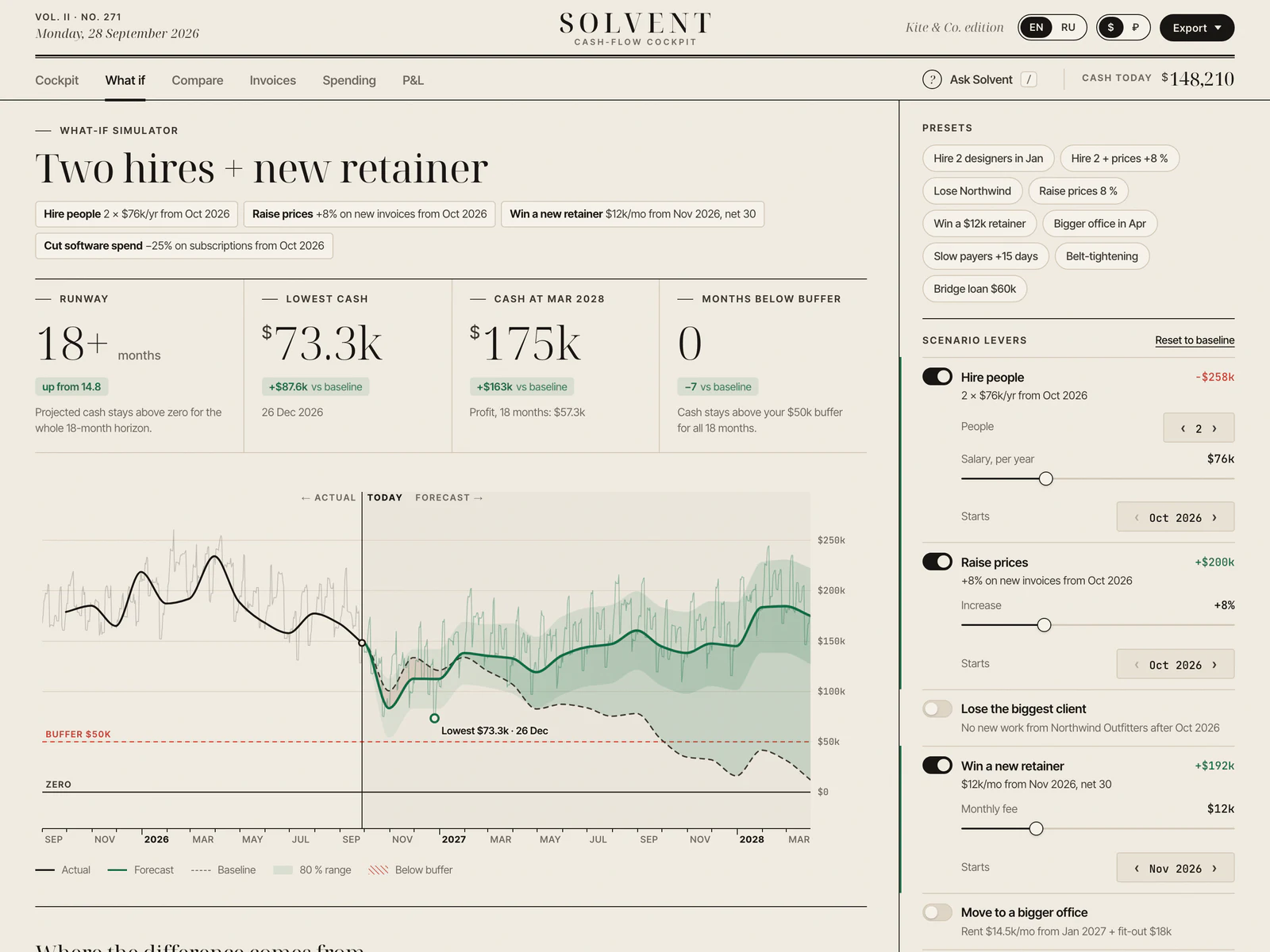
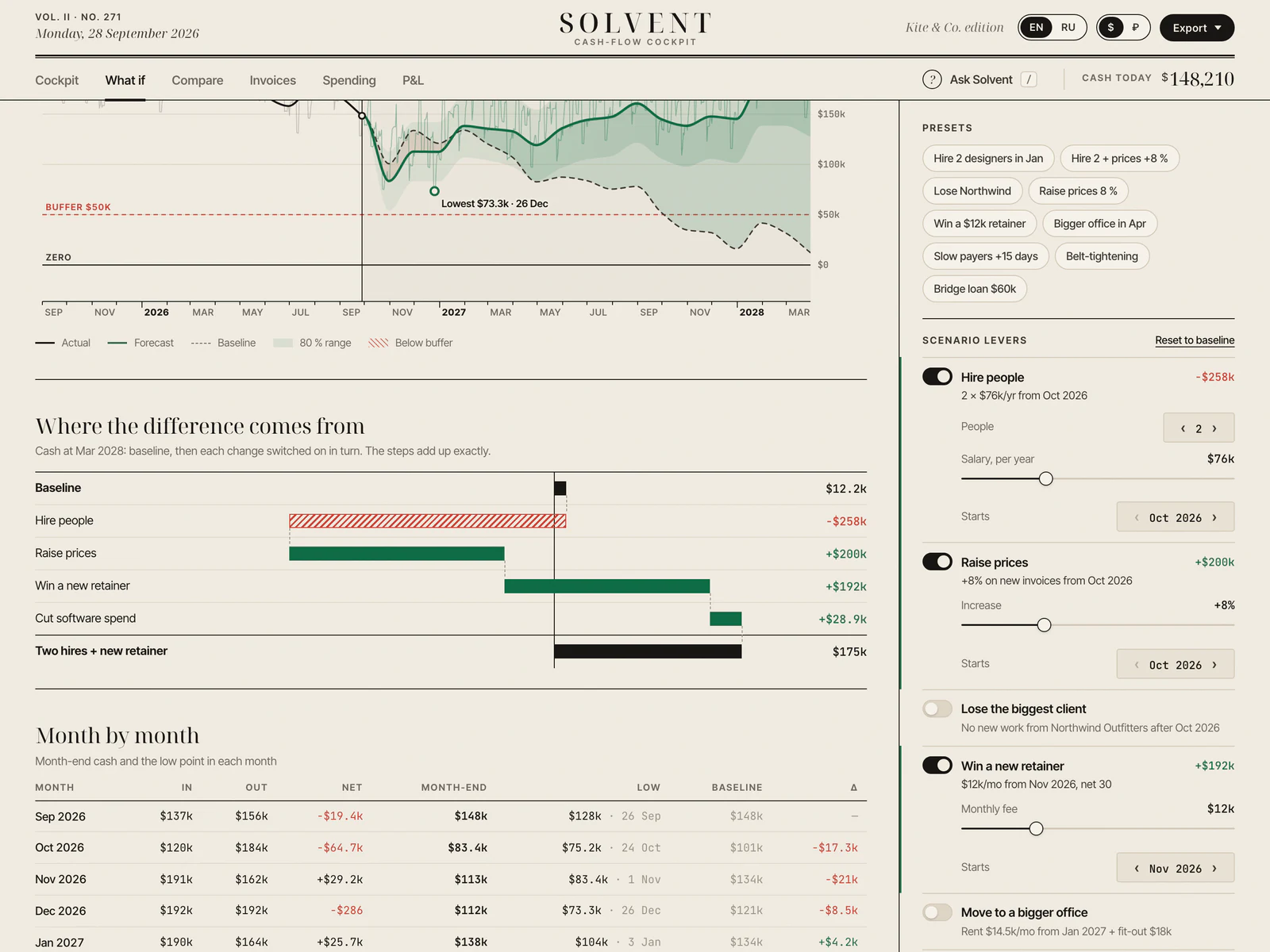
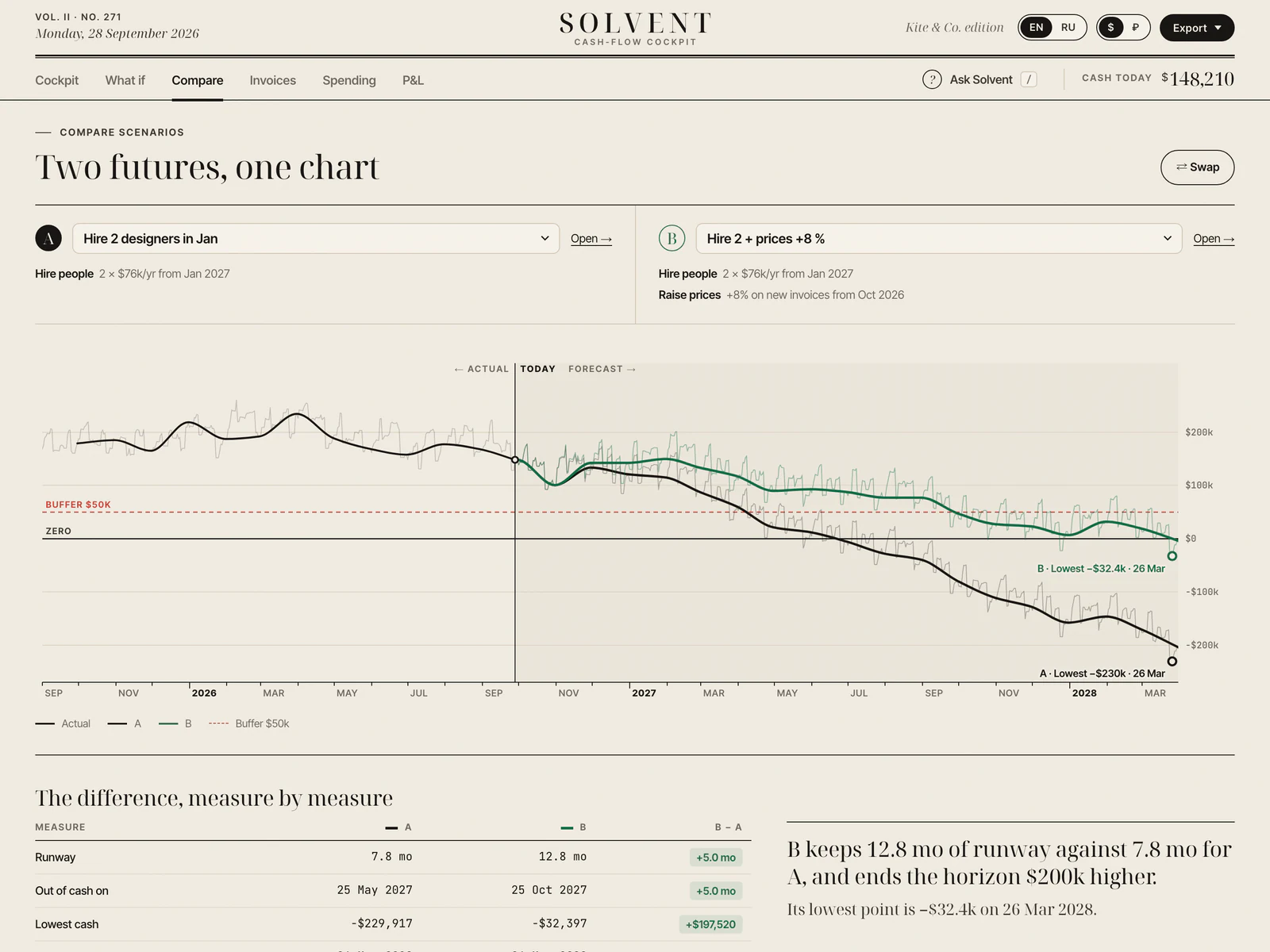
The what-if simulator has eight levers (hire, raise prices, lose a client, win a retainer, move office, slower payers, cut software, take a loan) and nine presets. Each change recomputes the forecast at once: figures roll, the curve morphs away from a dashed baseline, and a waterfall shows what each lever adds or takes, adding up exactly to the difference. Scenarios can be saved and compared two at a time. Around it sit receivables with ageing and reminder drafts, spending with rule-based categories and anomalies, a monthly P&L, and Ask Solvent, a question box that answers from the same engine.
Kite & Co.’s ledger is generated deterministically from per-month seeds: 24 months of invoices, payroll, rent, 14 subscriptions, seasonality and taxes. The app is plain JavaScript modules bundled with esbuild, with its own SVG charts, its own CSV export (with semicolons and decimal commas in Russian) and a one-page PDF produced by a minimal PDF writer of our own: no chart, UI or PDF library. It speaks English and Russian and shows dollars or roubles at a fixed demo rate.
Gallery
Results
The concept is a working web app at /demos/solvent/ with six sections (cockpit, what if, compare, invoices, spending, P&L), plus Ask Solvent and the exports. Its own test suite runs 1,927 checks on the maths: balance roll-forwards, the runway definition, waterfall sums, lever identities, determinism and the assistant’s answers. All of them passed on 28 September 2026.
All its JavaScript is 11 files, 220 KB, or 72 KB gzipped; the whole demo with fonts is 0.65 MB. In headless Chrome we opened every section in English on a desktop and in Russian on a 390 px phone, applied a scenario, marked an invoice paid and exported the CSV and the PDF: no errors, no sideways scroll and no request to any other server. On the live address, Lighthouse 13.5 gave performance 81 on mobile and 98 on desktop, with accessibility and best practices at 100 (medians of five runs, on a MacBook with a load average of 3–9).
What this does not prove
SOLVENT is a concept VITON13 built to show range, not a commissioned product. Kite & Co., its clients, suppliers and every figure are fictional; there are no customers, users, bank connections or revenue, and nothing here is financial advice. The forecast is a simple model (flat demand beyond seasonality, no churn when prices rise), and the assistant and the reminder drafts are demo AI: rules and statistics in the browser, not a language model.
The checks and timings come from one MacBook, headless Chrome and one day; Lighthouse ran on the live address, but it is a lab test with a simulated phone, not data from real visitors’ devices. A real version would need bank feeds, an accounting API, accounts and roles, encrypted storage and a review by finance professionals, and none of that is built.
Planning something similar? Our founder, Tarasov Vitalii, reads every message himself.
Order a similar project on VITON13 Studio
Next project
Brand filmsFilm & motion Internal2026
All work (32)
Internal2026
All work (32)