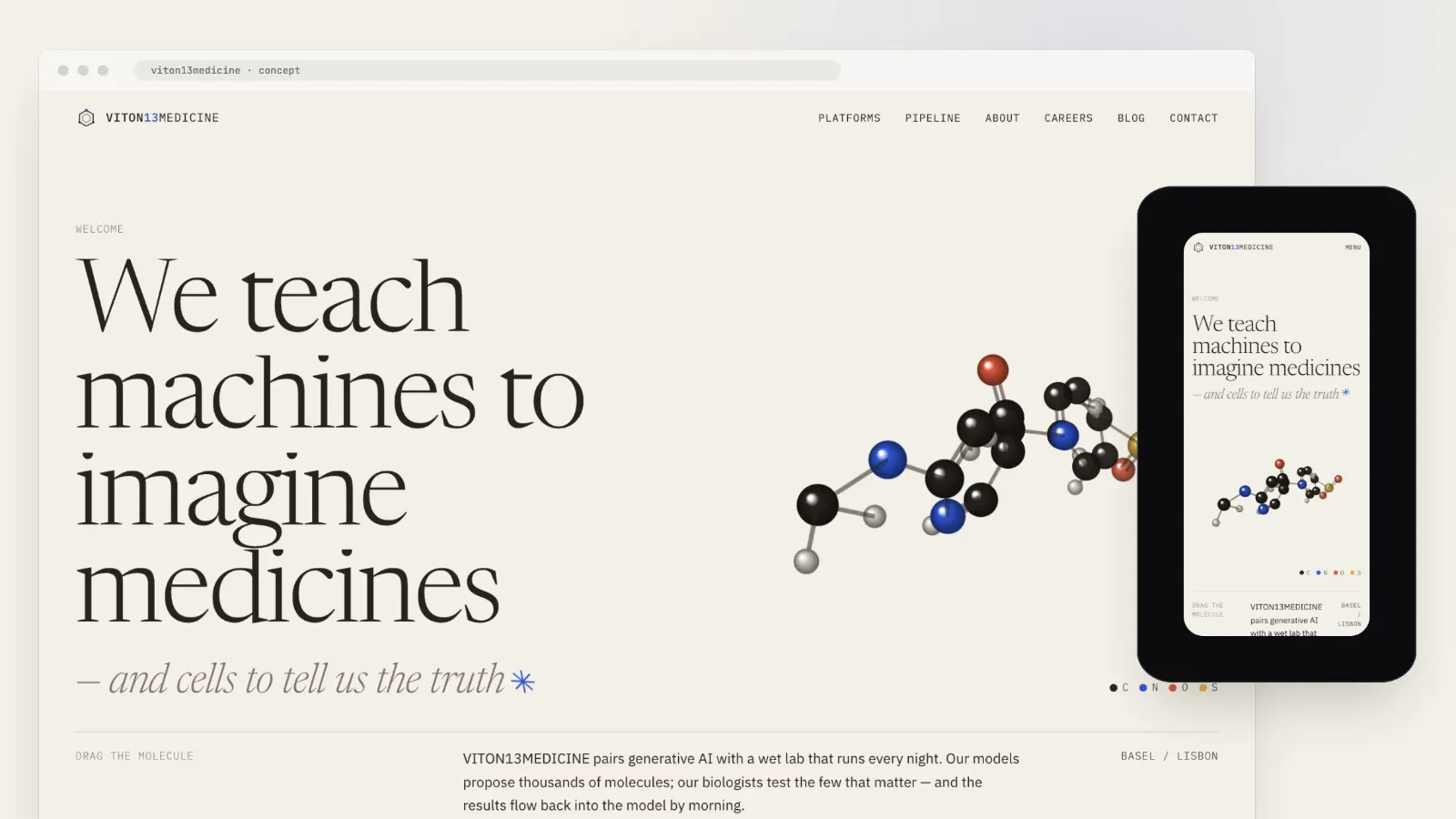
A concept site for a fictional AI drug-discovery biotech with an AI team in Lisbon and a wet lab in Basel: a draggable canvas molecule, a scroll-drawn DNA timeline and a 0.5 MB home page.
Overview
I built this concept to show how I would present a science company: a fictional biotech that uses AI to discover drug candidates, with an AI team in Lisbon and a wet lab in Basel. The site had to explain two technology platforms, a research pipeline, open roles and a blog to a reader who knows the field, without overstating anything.
Medicine raises the stakes for copy. Every programme on the site is fictional and preclinical, and no sentence may read as a health or efficacy claim. The site therefore needed a clear notice that the company is fictional and that nothing on it is medical advice.
11
pages, from the home page to the 404
Source: Site source files, 22 Sep 2026
5
fictional preclinical programmes in the pipeline
Source: Site source files, 22 Sep 2026
0.5 MB
home page weight in Lighthouse, 19 requests
Source: Lighthouse 13.4, 22 Sep 2026
75 / 99
Lighthouse performance, mobile / desktop
Source: Lighthouse 13.4, 22 Sep 2026
Approach
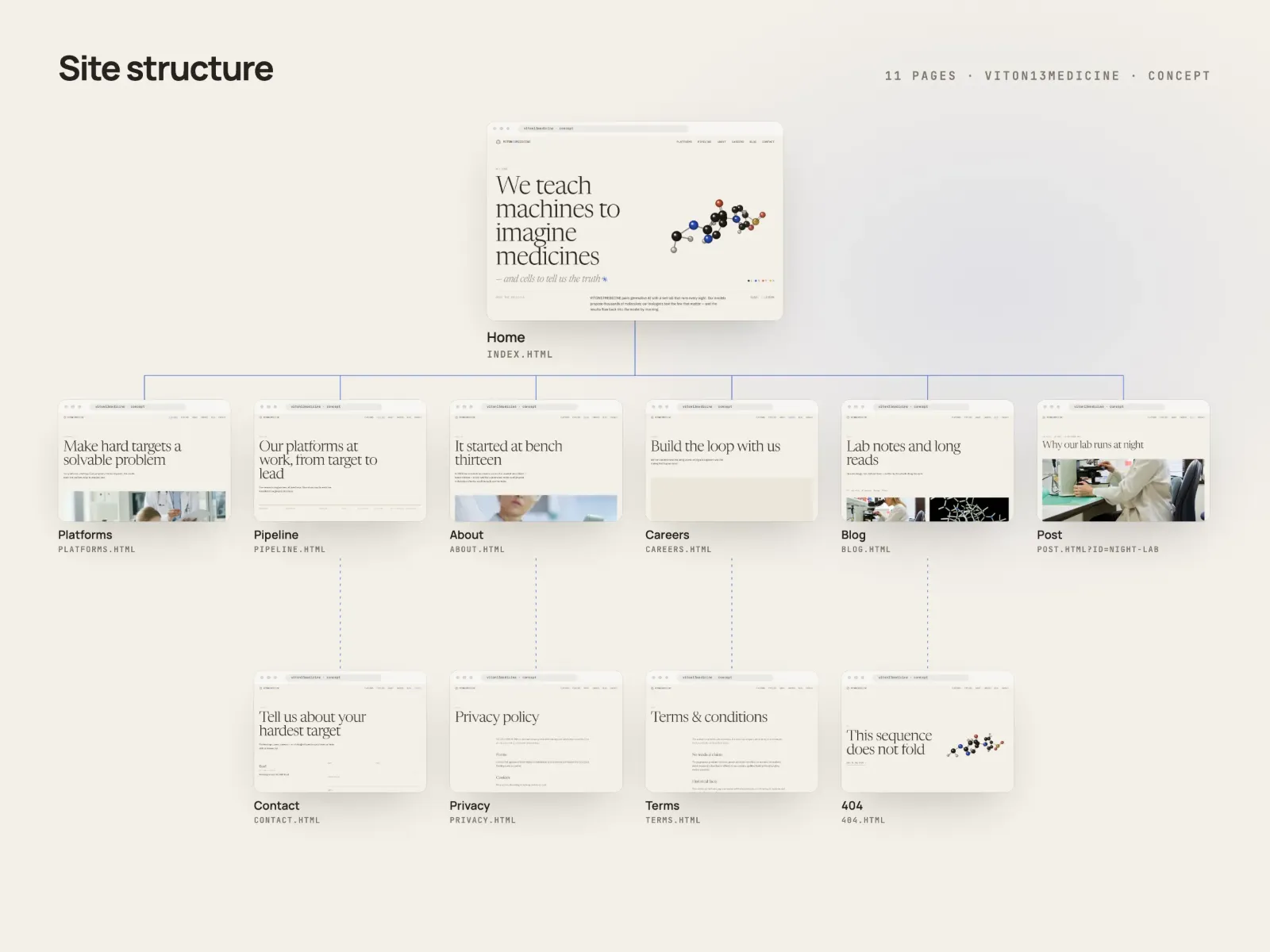
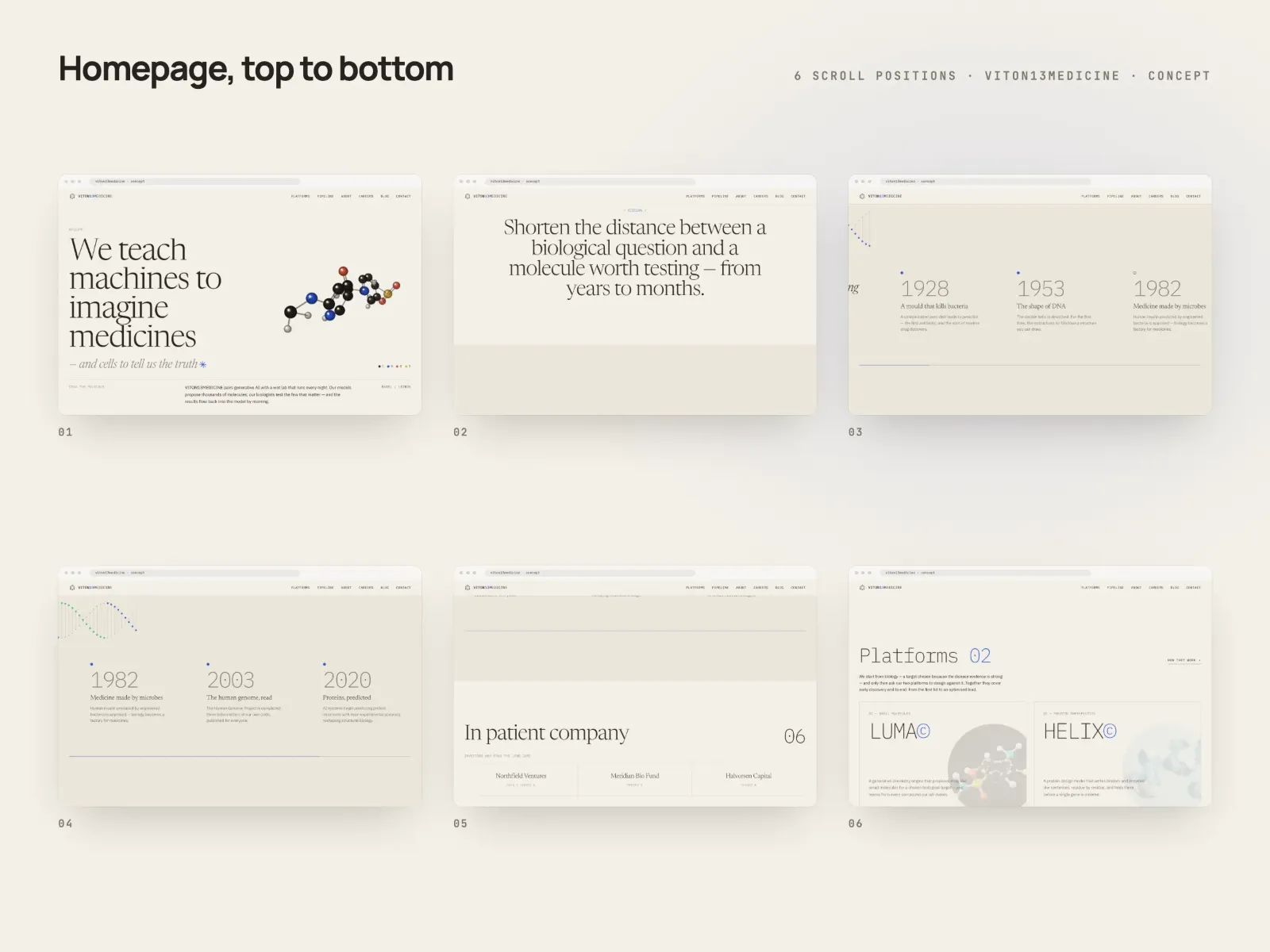
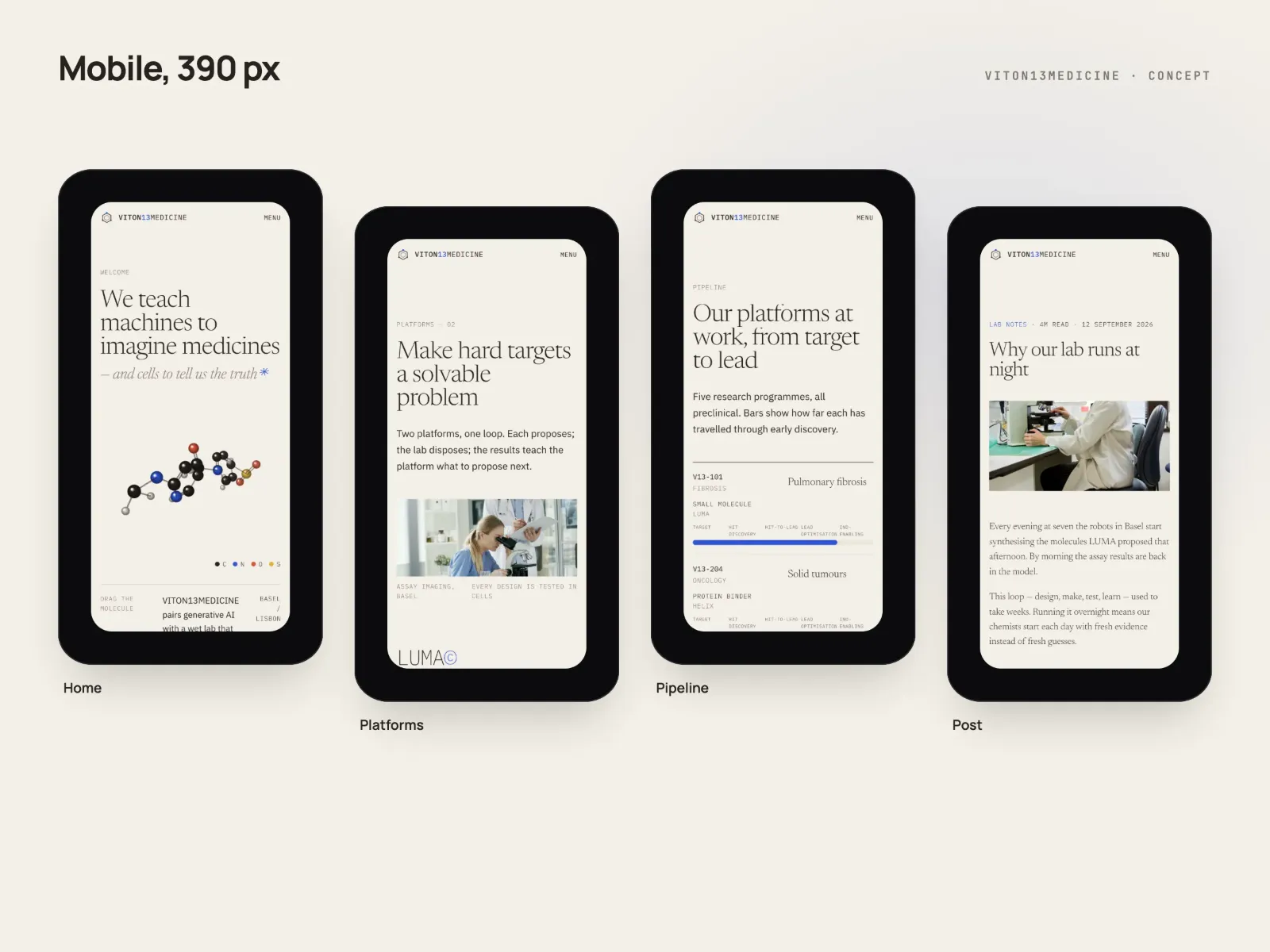
11 pages: Home, Platforms, Pipeline, About, Careers, Blog, a post template, Contact, Privacy, Terms and a 404. The home page opens with a 3D molecule drawn on canvas that the visitor can drag, followed by a history timeline of six milestones from 1928 to 2024 and an investors counter.
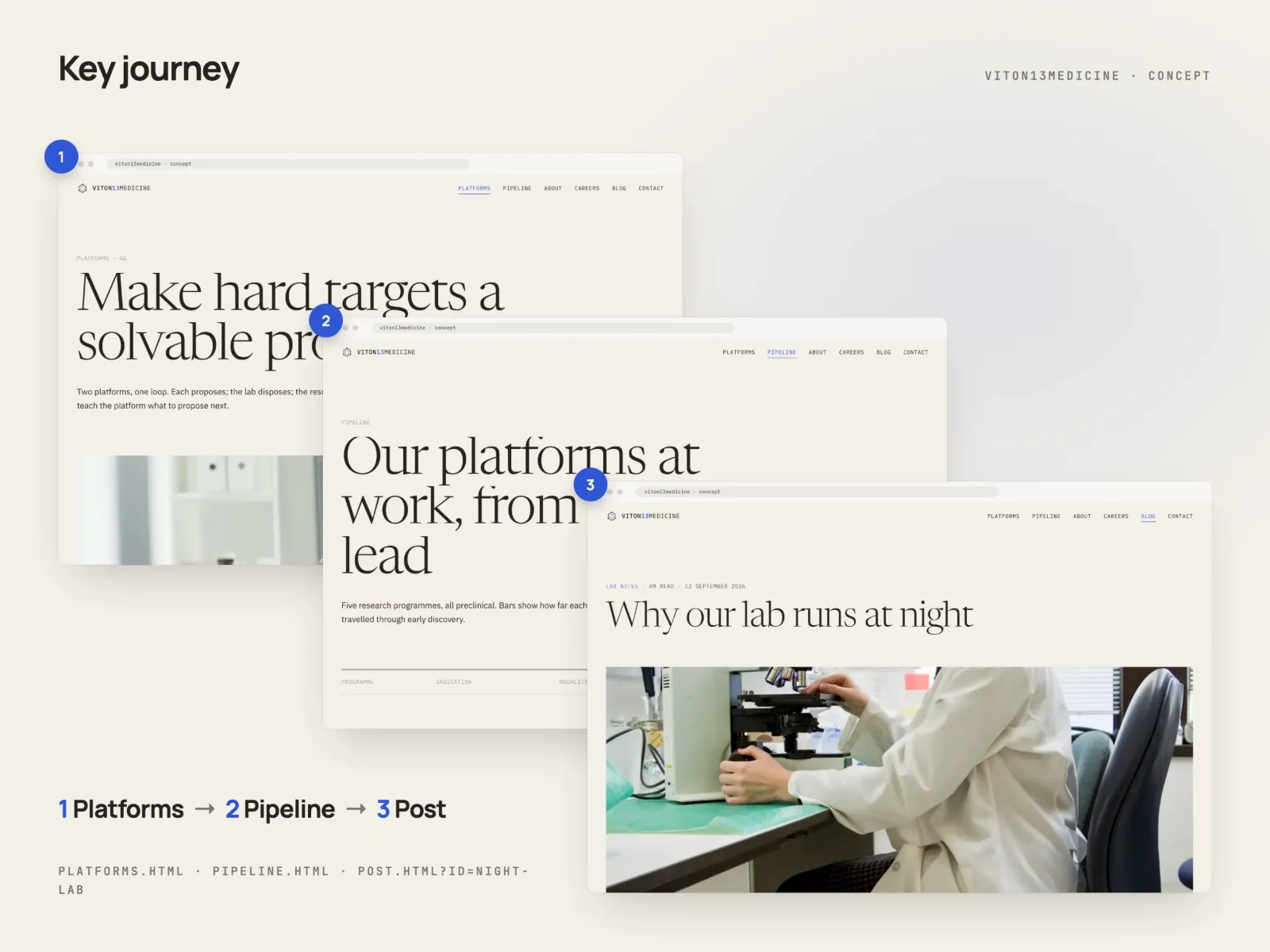
Platforms presents the two fictional platforms, one for small molecules and one for protein therapeutics, each with a problem, a solution and a design-make-test-learn loop. Pipeline shows five preclinical programmes in a table whose progress bars run across five discovery stages. Careers lists six open roles as an accordion; the blog has four posts with a category filter. The footer of every page says the company is fictional and the site is not medical advice.
Once dragged, the molecule keeps turning with inertia, tilts towards the cursor and refits its camera to stay in frame. Further down, the timeline pins and moves sideways while a DNA helix draws itself in step with the scroll; on phones it becomes a vertical list. Underneath is plain HTML, CSS and JavaScript with GSAP, ScrollTrigger and Lenis, and the molecule and helix are drawn on canvas without a 3D library.
Gallery
Results
The concept exists as 11 working pages in English. On 22 September 2026 Lighthouse measured the home page at 0.5 MB in 19 requests, the lightest of the seven concept sites. With mobile throttling it scored 75 for performance, with LCP at 4.3 s and CLS 0; on desktop it scored 99, with LCP at 0.6 s and CLS 0.021. Best practices scored 100 on both, with no third-party video loaded during the test, and SEO scored 100 on both.
Accessibility is the weak spot: 88 on mobile and 87 on desktop, because some text is too low in contrast and the headings are not in order. Across the 10 pages checked (all but the 404), all 10 have unique titles and one H1, every image has alt text and no internal link is broken.
SEO review
Lighthouse on the home page, 22 September 2026: SEO 100 and Best practices 100 on mobile and desktop, Performance 75 and 99, Accessibility 88 and 87. Across the 10 pages checked, titles, H1s, alt text and internal links are in order, but only 4/10 titles and 6/10 descriptions are the right length, and canonical, Open Graph, JSON-LD and sitemap.xml are missing (0/10) because the concept has no domain.
Lighthouse
Mobile
- Performance: 75 / 100
- Accessibility: 88 / 100
- Best practices: 100 / 100
- SEO: 100 / 100
- LCP
- 4.3 s
- CLS
- 0
- TBT
- 0 ms
- Weight
- 0.5 MB
Desktop
- Performance: 99 / 100
- Accessibility: 87 / 100
- Best practices: 100 / 100
- SEO: 100 / 100
- LCP
- 0.6 s
- CLS
- 0.021
- TBT
- 0 ms
- Weight
- 0.5 MB
In place across the 10 pages checked: unique titles (10/10), one H1 per page (10/10), the page language declared (en), a mobile layout without sideways scroll at 390 px, alt text on 100% of images and 0 broken internal links. On the home page Lighthouse measured LCP 4.3 s on mobile and 0.6 s on desktop, CLS 0 and 0.021, total blocking time 0 ms, and 0.5 MB in 19 requests.
Before launch: canonical URLs (0/10 now); Open Graph titles and images (0/10); JSON-LD (0/10): Organization with the fictional-company disclaimer kept visible, BlogPosting for posts, JobPosting for the open roles and BreadcrumbList; sitemap.xml and robots.txt (missing). Lengthen the six titles shorter than 30 characters (only 4/10 are 30–65) and the four descriptions under 70 characters (6/10 are 70–170). For accessibility, raise the contrast of the faintest text and put the headings in order. The medical copy stays free of health claims.
| Check | Result | Status |
|---|---|---|
| Unique page titles | 10/10 | Pass |
| Title length | 4/10 | Fail |
| Meta descriptions | 6/10 | Needs work |
| One H1 per page | 10/10 | Pass |
| Language attribute | en | Pass |
| Mobile-friendly | 390 px | Pass |
| Image alt text | 100% | Pass |
| Broken internal links | 0 | Pass |
| Canonical URLs | 0/10 | Fail |
| Open Graph tags | 0/10 | Fail |
| Structured data | 0/10 | Fail |
| XML sitemap | 0/2 | Fail |
What this does not prove
This is a concept I built at VITON13 to show range, not a commissioned project. The company, its platforms, programmes, investors, people and addresses are fictional. It has no domain, no visitors, no search traffic and no sales, and the images are licensed stock from Unsplash and Pexels.
The programmes are invented and preclinical; nothing on the site is evidence about a real medicine or medical advice, and the site says so itself. The Lighthouse scores are lab measurements of the home page on one day, and a Lighthouse SEO score of 100 covers the basics only: canonical URLs, Open Graph, JSON-LD and sitemap.xml are still missing.
Planning something similar? I read every message myself.
Next project
NUMBER ONE®Brand concept Concept2026
All work (19)
Concept2026
All work (19)