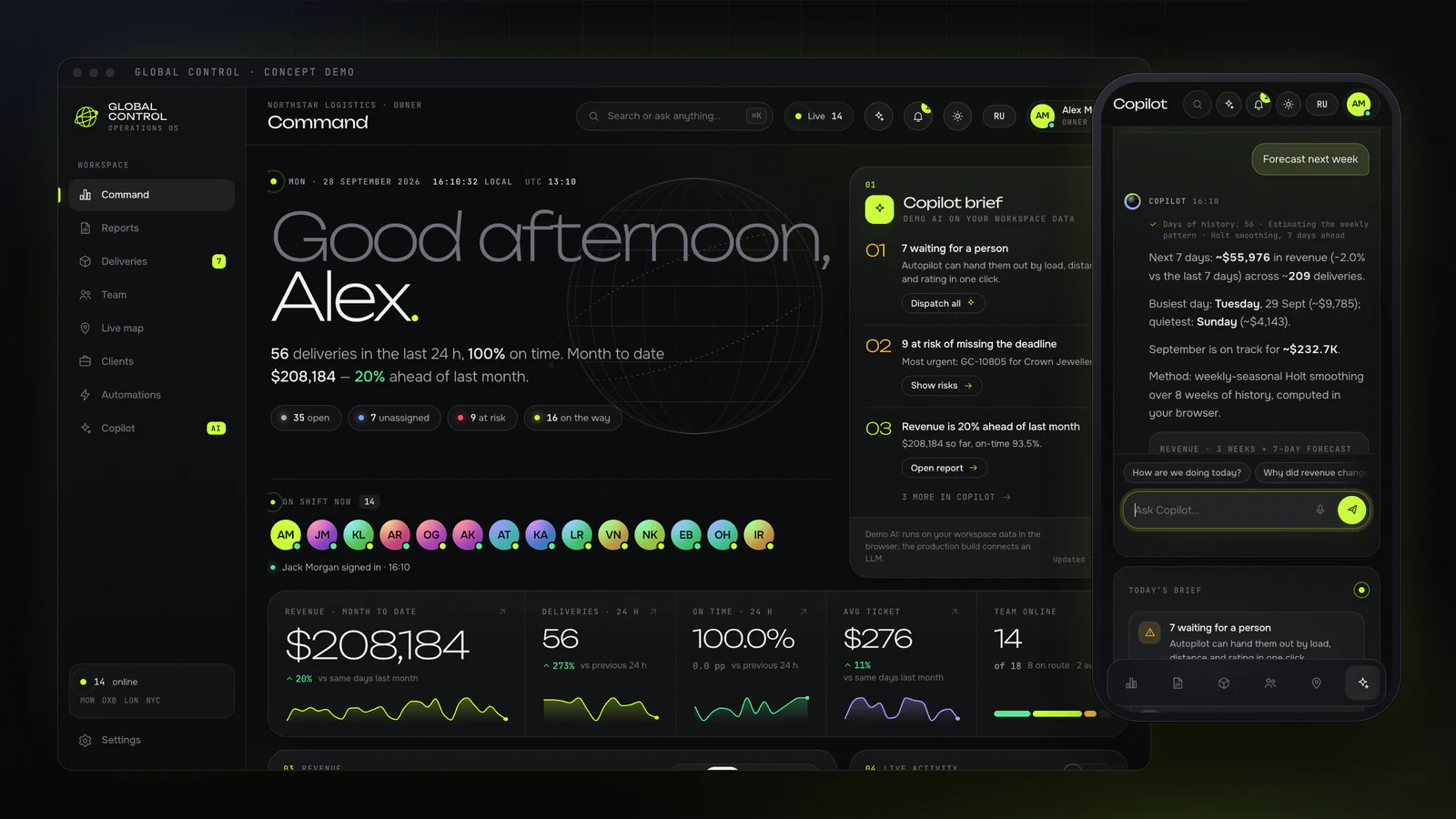
A concept operations CRM for a fictional logistics company: every visitor builds a sandbox with a team, clients and 14 days of orders, then runs it live in the browser with a demo AI copilot.
Overview
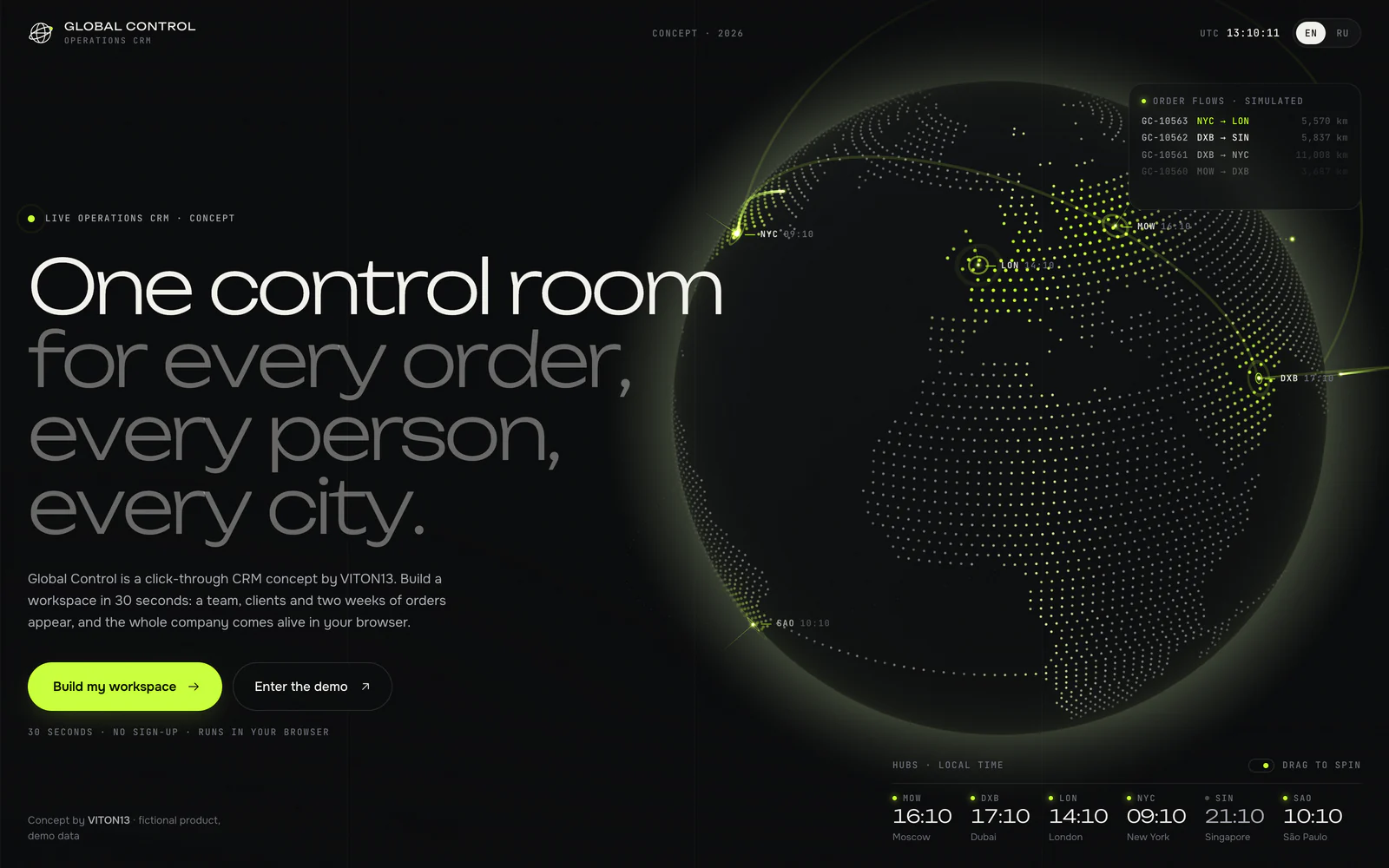
Global Control is an operations CRM we designed and built as a concept, shown through Northstar Logistics, a fictional delivery company with hubs in Moscow, Dubai, London and New York. It is the flagship of our product concepts: nine working modules in one browser app (a Command home screen, orders, team, a live map, clients, reports, automations, an AI copilot and settings), opened by an intro with a three.js globe.
The brief asked for a premium CRM in which a manager registers employees, hands out orders, tracks them, reads indicators and charts, downloads monthly and yearly reports, gets a notification when someone signs in and works with an AI that adapts to the person, and in which a visitor can click everything and create things of their own. So every visitor builds their own sandbox in a short onboarding and gets a fictional team, clients and two weeks of orders, and a live simulation keeps the company moving while they look. Nothing leaves the browser: the workspace is kept in localStorage.
9
working modules in one browser app, plus the intro and a ⌘K palette
Source: Counted 28 Sep 2026, app router and build
35
copilot intents, understood in English and Russian
Source: Counted 28 Sep 2026, copilot source
2,045
interface strings in each of English and Russian, none missing
Source: Counted 28 Sep 2026, build-time audit
79 / 97
Lighthouse performance, mobile / desktop (medians of 5 runs)
Source: Measured 28 Sep 2026 on the live address
Approach
The onboarding asks for a name, a role (owner, manager or employee), a company name, an industry, a team size from 8 to 30, a currency and an accent colour. A seeded generator builds the workspace from the answers: in the default demo, 18 people in four hubs, 22 clients, about 400 orders over 14 days and six automations, with a generated history behind them so monthly and yearly reports always have data. The industry changes the vocabulary everywhere (deliveries and couriers, jobs and technicians, or orders and pickers), the role changes the home screen (money and growth for an owner, the dispatch queue for a manager, “my day” for an employee), and the menu reorders itself by what the person actually uses. The simulation signs people in and out with a notification, brings in new orders, moves couriers along their routes and completes deliveries, with every hub on its own local time.
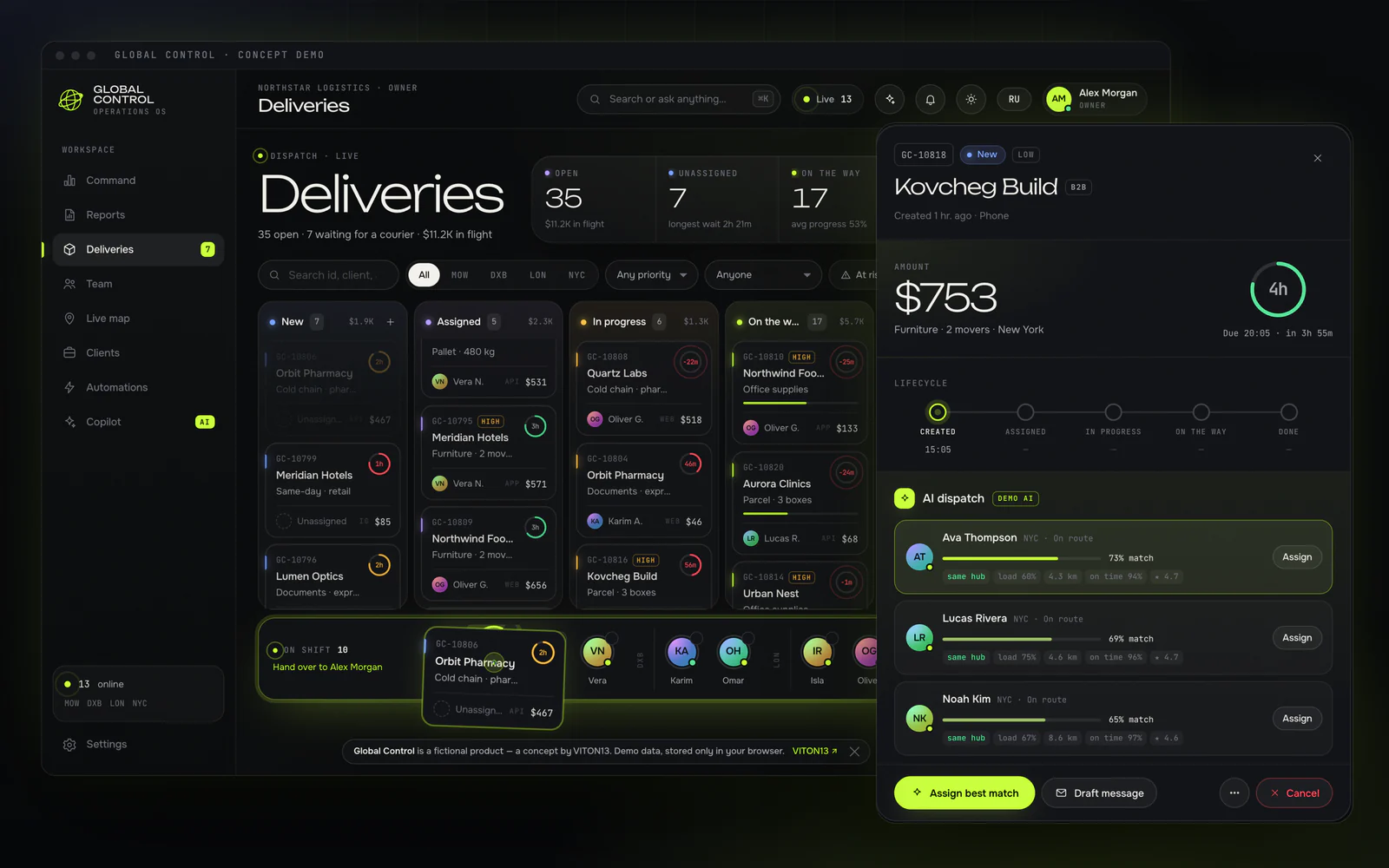
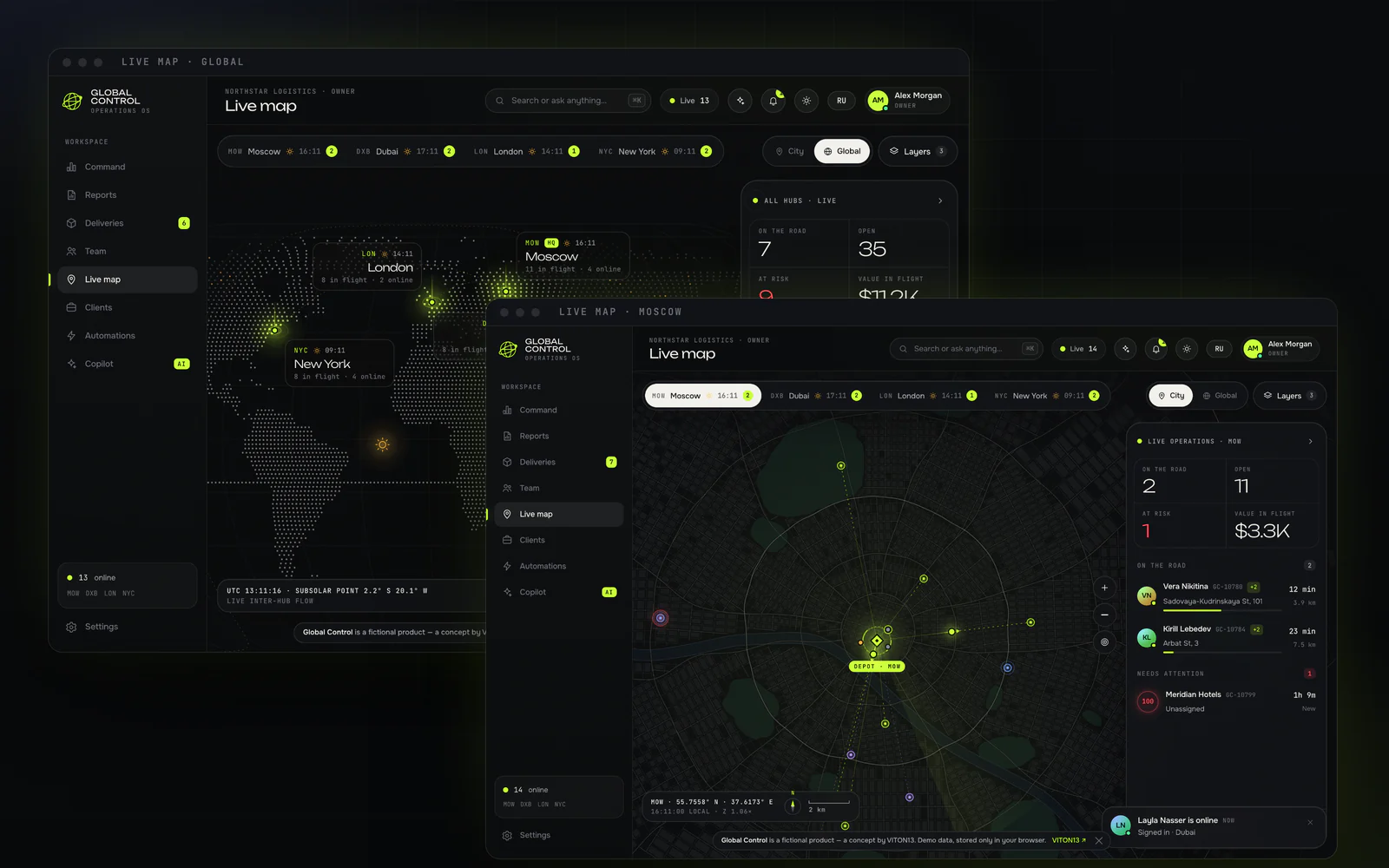
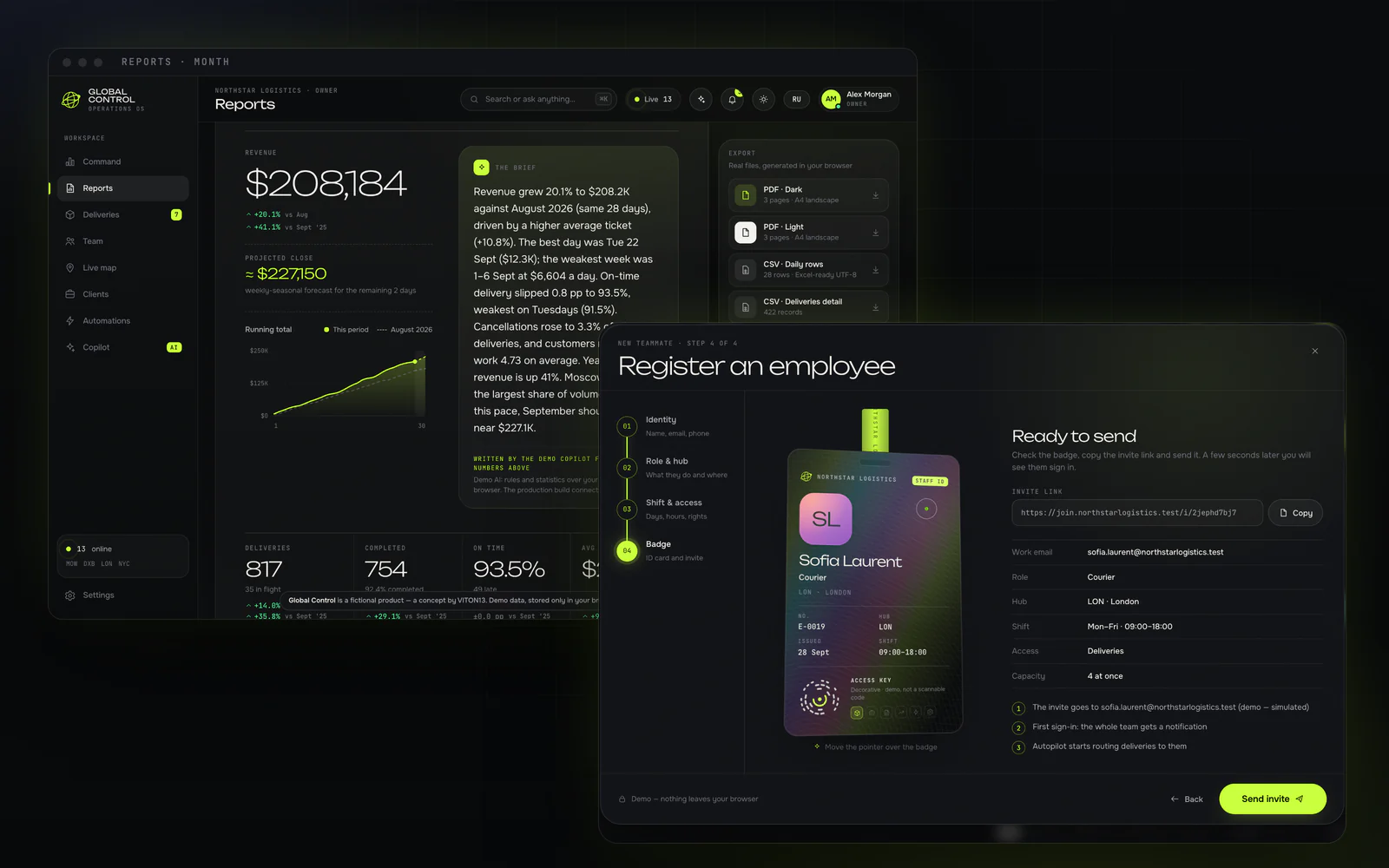
Orders is a board with drag and drop between statuses and onto people, a live SLA ring on every card, and a drawer in which AI dispatch ranks the team by hub, load, distance, on-time rate and rating and shows its reasons. Team registers an employee in four steps and ends with a holographic badge that tilts under the pointer; a few seconds after the invite, the new person “signs in” and the whole team is notified. The live map draws a procedural city for each hub with couriers moving through it, and a global view with the real day-and-night line. Reports cover a month, a quarter or a year and download as a PDF made by our own minimal PDF writer, as CSV that opens correctly in Excel in both languages, or as JSON. Automations run as live flows of nodes, and the builder turns a rule written in English or Russian into a trigger, conditions and actions, then replays it on the last 14 days. Clients carry an explainable health score.
The copilot is what we call demo AI, and the product labels it that way: an on-device language layer with typo-tolerant matching in English and Russian, 35 intents and entity extraction, which answers with live numbers from the workspace and acts through the same functions a person uses, from dispatching the queue to exporting a report. A proactive layer offers a one-click fix for an order at risk at most every 45 seconds, and ⌘K opens a command palette. Underneath: plain JavaScript and CSS bundled with esbuild into 43 lazily loaded files, three.js only for the intro globe, three self-hosted variable fonts (Unbounded, Onest and JetBrains Mono), a night and a day theme, and 2,045 interface strings in each language.
Gallery
Results
The concept runs at /demos/global-control/ with nine modules, the intro and a command palette, in English and Russian. On 28 September 2026 we checked it ourselves in headless Chrome on a local copy served with the portfolio’s production headers and content security policy: 13 routes at desktop and phone widths, the three roles, the Russian interface, the intro with the onboarding, and the main interactions (AI dispatch, a new order, a registration through to the badge, six copilot questions, ⌘K, a rule written in words, PDF and CSV exports) ran with zero console errors, zero CSP violations and zero failed requests. The monthly report came out as a valid three-page PDF and the daily CSV with one row per day.
The first script, app.js, weighs 3.3 KB gzipped; all 43 JavaScript files and the stylesheet come to 573 KB gzipped, 138 KB of it three.js for the intro. A first visit transfers 528 KB in 25 requests. On the live address, Lighthouse 13.5.0 (5 runs per device, medians, on a MacBook with a load average of 3–9) gave performance 79 on mobile and 97 on desktop, accessibility 100 and best practices 100; on a phone the score is held back by the largest paint, the intro’s subtitle, which appears at 3.7 s after a short preloader.
What this does not prove
Global Control is a concept VITON13 built to show range, not a commissioned project. Northstar Logistics, its people, clients, orders and money are fictional and generated in the visitor’s browser: there is no client, no users, no real deliveries, no traffic and no revenue, and nothing in the demo is for sale. Invites, messages, e-mails and sign-ins are simulated, and no data leaves the browser.
The copilot, AI dispatch, the forecasts and the rule builder are demo AI: on-device intent parsing, rules and statistics, not a language model, so they say nothing about how a model would do on a real operation. The simulation runs on compressed time. Every figure is a lab measurement in headless Chrome on one machine on one day: the walk-through ran on a local copy with the production headers, Lighthouse on the live address with a simulated phone, and no user testing was done. A production version would still need a server, accounts and permissions, real notifications, integrations and data protection.
Planning something similar? Our founder, Tarasov Vitalii, reads every message himself.
Order a similar project on VITON13 Studio
Next project
HYPERSOLIDImmersive WebGL concept site Concept2026
All work (32)
Concept2026
All work (32)