Work Company website
viton13.com
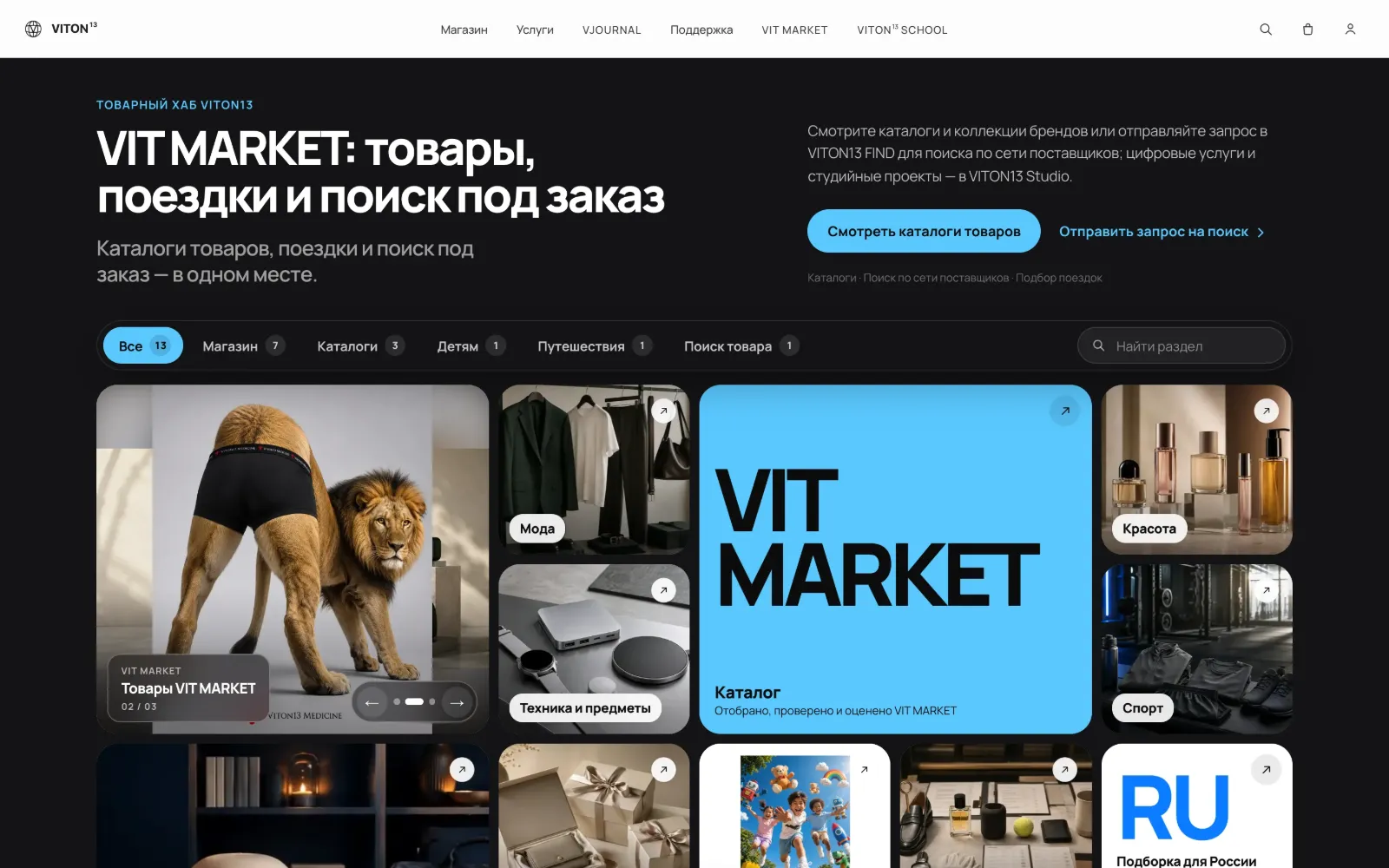
VITON13’s own website: one Next.js application serving the main domain and six subdomains in five languages, with a crawl of internal routes before every release goes live.
Overview
VITON13 is one company with several parts: a studio, a store, the journal VJOURNAL, the marketplace VIT MARKET, a school and a support centre. It needed one website that holds all of them in English, Russian, Spanish, French and Hindi and gives each part an address of its own.
Releases also had to stay safe. With thousands of pages in five languages, a broken route or a missing language edition is easy to ship and hard to notice, so every release needed a check before it reached visitors.
5
language editions
Source: Live site, 19 Sep 2026
7
hosts: viton13.com and six subdomains
Source: Live site, 19 Sep 2026
7,215
URLs in the seven live sitemaps
Source: Live sitemap.xml files, 19 Sep 2026
18,987
internal routes checked in the 19 September release crawl
Source: Release log, 19 Sep 2026
Approach
One Next.js 16 application, built with React 19, serves seven hosts: viton13.com for the company pages and the research library, and subdomains for the studio, store, journal, market, school and support. English is served without a prefix; the other editions live under /ru, /es, /fr and /hi.
Each host publishes its own sitemap. Pages list their language editions with hreflang tags and leave out any edition that is closed to indexing. Old section addresses on the main domain answer with a permanent 308 redirect to their subdomain: viton13.com/journal, for example, now opens journal.viton13.com. The robots.txt names 13 AI and search agents, and the application sends Content-Security-Policy, HSTS with preload, X-Frame-Options DENY and Permissions-Policy headers.
A release is built on the server and has to pass several gates before it goes live: SEO and content checks, the production build, and a crawl of the built release started on an isolated port. If a gate fails, the release stops and the live site stays as it was. After the switch, 76 routes are requested across the subdomains; if that verification fails, the previous release is restored automatically, and ten rollback copies are kept.
Gallery


Results
On 19 September 2026 the seven live sitemaps listed 7,215 URLs: 5,427 on the journal, 1,130 on the studio, 255 on support, 230 on the store, 105 on the market, 63 on the main domain and 5 on the school. The main domain’s 63 include the 17 published studies of the research library.
That day the release crawl checked 18,987 unique internal routes and found no broken responses, and on the live site 40 of 40 AI service pages on the studio and 32 of 32 checks on the VIT MARKET catalogue passed. The release took about 40 minutes from start to the last live check; the codebase carries 175 automated test files.
The SEO release gate passed its 21 checks with no warnings, and the live pages carry the build ID recorded in that release log, so these figures describe the site that was live that day.
What this does not prove
This case shows how the site is built and released, not how it performs with visitors. It is VITON13’s own site, not a client project. No Lighthouse or Core Web Vitals measurements were taken, so it makes no speed claim, and it reports no traffic, rankings, leads or sales.
A URL in a sitemap is an invitation to crawl, not proof of indexing. The 308 redirects are in place, but this case does not measure whether search positions carried over to the subdomains. The release crawl covers internal routes only; links to other sites are not checked.
Want something like this? Tell me about your project.